Blog
Commercial Roof Restoration vs. Roof Replacement: A Cost Comparison for San Gabriel Valley Property Owners
June 17, 2026
Commercial Roof Restoration vs. Replacement: A Real Cost Comparison for San Gabriel Valley Property Owners
When a contractor hands you a proposal for a full roof replacement, the number is rarely small, and the pressure to sign is rarely small either. For property managers answering to ownership on maintenance budgets, small-business owners watching cash flow, and retired building owners who’ve learned to question contractor recommendations, the critical question is always the same: do I actually need to replace this roof, or is there a smarter path?
The debate around commercial roof restoration vs replacement is one where the financial stakes are real and the expertise gap between contractor and client is wide. This guide exists to close that gap. We’ll walk through what honest inspections reveal, what restoration can and cannot fix, how the numbers actually compare in the San Gabriel Valley market, and what questions will expose a contractor who’s steering you toward the more expensive option for the wrong reasons.
What Roof Restoration Actually Means, and What It Can Do
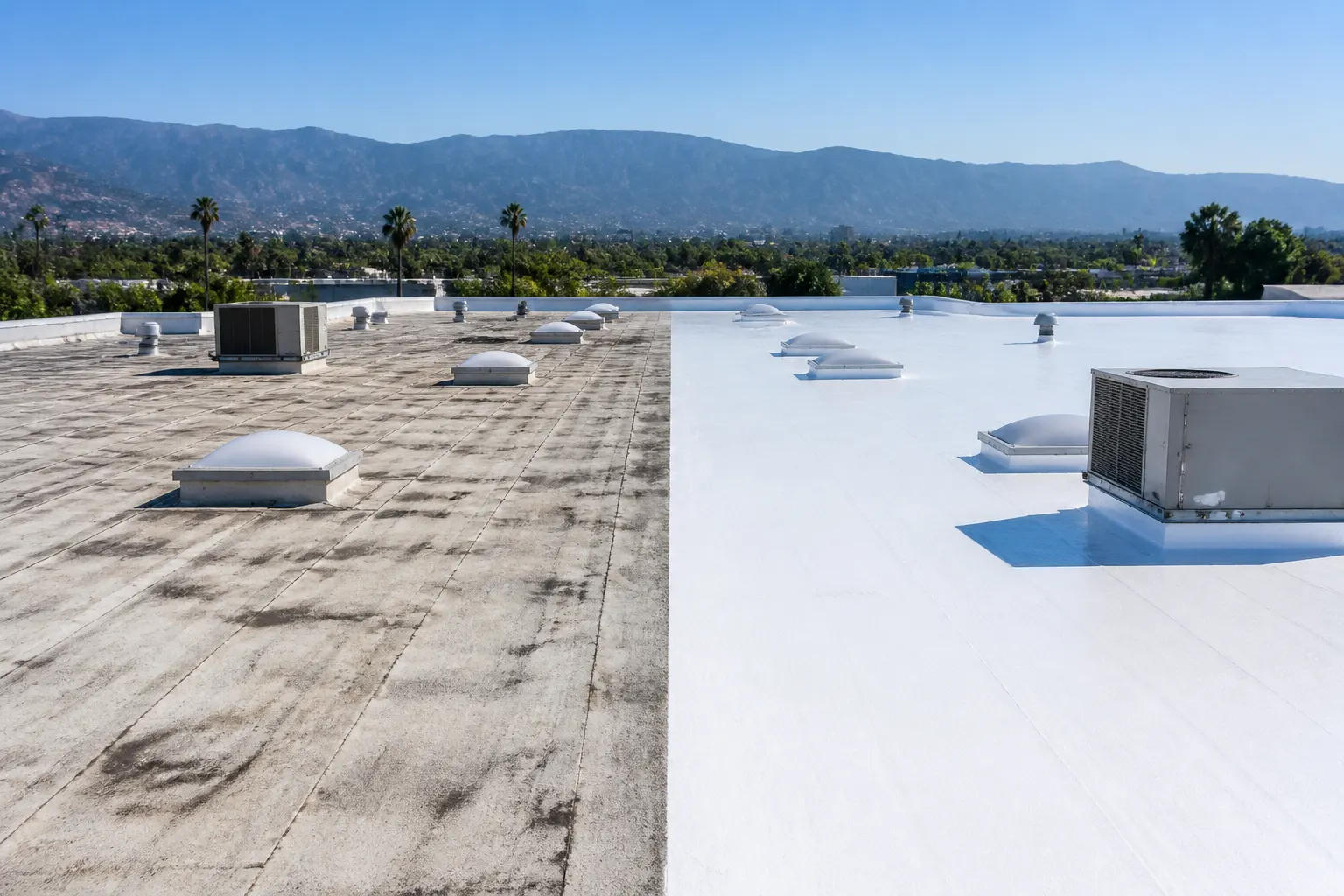
Restoration is not a patch job. It’s a system-level solution that encapsulates an existing roof membrane with a high-performance coating, extending useful life by 10 to 20 years without the cost and disruption of a full tear-off.
The most advanced version of this approach is a seamless cool-roof coating system, a monolithic coating applied over a properly prepared substrate that eliminates seams (the primary point of failure on most flat commercial roofs), reflects solar heat, and can be designed to meet California’s Title-24 energy compliance requirements. For property owners in Alhambra, CA and throughout the San Gabriel Valley, where rooftop temperatures regularly exceed 150°F in summer, the thermal performance benefits alone are significant.
Restoration works best when:
- The existing membrane is structurally sound with no widespread delamination
- Wet insulation (measured by infrared scan or core sample) covers less than 25% of the roof area
- Seams are failing or separating but the field membrane remains intact
- The roof has one or two previous coatings but hasn’t been built up beyond manufacturer thickness limits
- The building owner wants to avoid business interruption from a multi-day tear-off project
When these conditions are met, restoration delivers full waterproofing protection at a fraction of replacement cost.
The Real Cost Difference: What the Numbers Look Like
This is where the conversation usually gets uncomfortable, because the gap is larger than most property owners realize.
In the greater Los Angeles commercial roofing market, including the San Gabriel Valley:
- Full tear-off and replacement typically runs $8 to $18 per square foot, depending on membrane type, insulation requirements, deck condition, and disposal costs. For a 10,000-square-foot roof, that’s $80,000 to $180,000.
- Roof restoration with a seamless cool-roof coating system typically runs $3 to $7 per square foot, roughly 40 to 60 percent of replacement cost. The same 10,000-square-foot roof: $30,000 to $70,000.
The savings aren’t just in materials. Tear-off generates significant landfill disposal costs. It requires temporary business disruption, coordination around equipment and inventory, and sometimes temporary weatherproofing during the work window. Restoration eliminates most of these friction costs.
What doesn’t get mentioned often enough: restoration costs are generally treated as a maintenance expense for tax purposes, while replacement may need to be capitalized and depreciated. For small-business building owners and property managers working with ownership on budget justification, that distinction matters.
To understand how material selection affects the long-term cost equation, the commercial roofing materials comparison for California breaks down TPO, PVC, modified bitumen, and restoration systems side by side, useful context before any major decision.
What an Honest Inspection Should Actually Tell You
An honest inspection separates contractors from salespeople. Here’s what a legitimate assessment of a commercial roof should include, and what the findings should actually mean for your decision.
Infrared moisture scan. This is non-negotiable for any restoration evaluation. Infrared technology identifies wet insulation by detecting temperature differentials that aren’t visible to the naked eye. If a contractor is recommending replacement without an infrared scan, they’re guessing, or they already know what they want to recommend.
Core samples. Pulling physical samples from suspect areas confirms whether moisture has penetrated the insulation and how many existing coating layers are present. This matters because most coating systems have a maximum recoat thickness.
Membrane adhesion testing. A restoration coating needs a sound substrate to adhere to. Adhesion pull tests confirm whether the existing membrane can support a new system.
Drain and penetration evaluation. Most commercial roof leaks originate at penetrations (HVAC equipment, drains, curbs, skylights) rather than in the field membrane. A contractor recommending full replacement because of penetration failures may be significantly oversizing the scope of work.
Written findings, not just a quote. A professional inspection should produce a written report with photographs, moisture mapping, and specific findings, not a verbal summary followed by a replacement proposal. If you’re only receiving a number, ask for the data behind it.
Property managers with ongoing roof care responsibilities will also find value in scheduling regular commercial roof inspections as part of a proactive maintenance program, catching problems at the minor-repair stage before they become restoration-or-replacement decisions.
When Replacement Is the Honest Answer
Restoration is powerful, but it isn’t appropriate for every roof. There are conditions where full replacement is the correct recommendation, and a contractor who pushes restoration when replacement is warranted is just as problematic as one who pushes replacement unnecessarily.
Replace rather than restore when:
- Wet insulation exceeds 25% of the roof area. At this point, the insulation has lost its R-value and the trapped moisture will continue to cause problems beneath any new coating. Replacement allows the wet material to be removed.
- The roof deck is structurally compromised. Wood decks with rot, metal decks with rust-through, or concrete decks with significant cracking need to be addressed at the structural level, not coated over.
- The roof has exceeded its service life by a significant margin. Most commercial flat roof membranes are warranted for 15 to 20 years. A 30-year-old modified bitumen roof that has been repeatedly patched may not provide adequate adhesion for a restoration coating.
- Multiple previous coating layers are already present. Most manufacturers limit systems to a specific total thickness. If the roof has already been restored twice, a third coating may not be manufacturer-approved.
- Code compliance requires a new system. Certain permit triggers in Los Angeles County require full replacement rather than over-roofing. An honest contractor will identify these triggers upfront rather than after work has begun.
For California building owners weighing a major capital expenditure, the commercial roof replacement planning guide for Inland Empire property owners covers the planning process in detail, including how to stage a replacement project to minimize cash flow impact.
The Questions That Expose Unnecessary Upselling
The asymmetry of expertise in roofing is real. Most building owners don’t know what questions to ask, which makes it easy for a contractor to control the narrative. These questions change the dynamic.
“Can you show me the infrared scan results?” If they haven’t done one, ask why not. If they have, ask them to walk you through where the wet areas are and what percentage of total roof area they represent.
“What is the current membrane adhesion reading?” This is a testable, objective finding. A contractor who can’t answer this question hasn’t done a proper evaluation.
“What would restoration cost compared to replacement, and why isn’t restoration appropriate here?” Force the comparison onto the table. If the answer is vague or dismissive, that tells you something.
“Are you a certified applicator for the restoration system you’re proposing?” Manufacturer certification matters for warranty validity. Ask for documentation.
“What percentage of your commercial work is restoration versus replacement?” A contractor who only does replacement has a financial incentive to recommend it. That’s not a disqualifier, but it’s context worth having.
If you want a broader framework for evaluating contractor credibility before you get to this point, the guide on how to spot unreliable commercial roofing contractors covers the warning signs that appear well before a proposal is ever submitted.
Energy Efficiency and California Compliance: The Hidden Advantage of Restoration
For San Gabriel Valley property owners, there’s a dimension to the restoration vs. replacement conversation that often goes undiscussed: California’s energy code requirements and what restoration can do for your utility costs.
California’s Title-24 energy compliance standards apply to commercial roofing projects above certain thresholds. Cool-roof systems, whether installed as part of a restoration or a replacement, that meet reflectance and emittance requirements can satisfy these mandates while delivering measurable energy savings.
Reflective coating systems in the Alhambra, CA area routinely reduce rooftop surface temperatures by 50 to 80°F compared to dark-membrane roofs. For commercial buildings with significant cooling loads, retail, warehousing, light industrial, that translates directly to lower HVAC costs. Some building owners have reported 15 to 25% reductions in cooling energy consumption following a cool-roof restoration.
If your existing roof is a dark modified bitumen or built-up system, restoration with a white reflective coating may offer more energy-efficiency gain per dollar spent than a replacement using a standard membrane, even a white TPO. For a deeper look at coating options and their performance characteristics, the acrylic roof coating comprehensive guide is worth reviewing before you finalize any decision.
Making the Right Call for Your Building
The decision between commercial roof restoration and replacement isn’t a judgment call that should be left entirely to the contractor proposing the work. It’s a data-driven analysis that starts with a thorough inspection, includes objective moisture testing, accounts for your building’s specific condition and use, and weighs both short-term cash flow and long-term capital planning.
For most commercial flat roofs in good structural condition with localized moisture intrusion, restoration is the financially responsible choice, delivering full waterproofing protection at 40 to 60% of replacement cost, with the added benefit of energy performance that matters in a Southern California climate.
For roofs with widespread wet insulation, structural compromise, or conditions that put them outside the parameters of an approved restoration system, replacement is the honest answer, and a contractor who tells you otherwise when the data says replace is just as problematic as one pushing unnecessary replacement.
The San Gabriel Valley commercial property market rewards owners who ask better questions and demand better data. That’s a standard every legitimate roofing contractor should be able to meet.
Ready for an inspection that gives you actual findings, not just a number? Contact HP Roofing Pro today for a professional commercial roof assessment serving Alhambra, CA and the greater San Gabriel Valley. We’ll tell you what your roof actually needs, and show you the data to back it up.
HP Roofing Pro serves commercial property owners throughout Alhambra, CA and the Los Angeles County commercial roofing market. Our assessments include infrared moisture scanning, written findings, and honest recommendations backed by manufacturer certifications.
Internal Link Audit:
- commercial roof coating restoration, Section 1, flagship service, contextually natural ✓
- commercial roofing materials comparison for California, Section 2, anchor article, contextually natural ✓
- regular commercial roof inspections, Section 3, primary service, contextually natural ✓
- commercial roof replacement planning guide for Inland Empire property owners, Section 4, anchor article, contextually natural ✓
- how to spot unreliable commercial roofing contractors, Section 5, anchor article, contextually natural ✓
- acrylic roof coating comprehensive guide, Section 6, anchor article, contextually natural ✓
- Los Angeles County commercial roofing market, Footer/closing, location hub, contextually natural ✓
Total links: 7 | Distribution: spread across all major sections | No avoided anchors used | Brand name not used as anchor | No link stacking