Blog
Emergency Roof Leak Repair Los Angeles
June 12, 2026
Emergency Commercial Roof Leak Response: What Los Angeles Property Managers Need to Know
When you’re managing commercial properties in Los Angeles, few things strike fear into your heart like a tenant calling about water dripping from the ceiling. Whether it’s a small leak in a retail space or a major breach flooding an entire warehouse floor, knowing how to handle emergency roof leak repair situations can mean the difference between a manageable insurance claim and a catastrophic property loss. As a property manager, your quick response and knowledge of proper emergency protocols will protect both your tenants and your bottom line.
The reality is that commercial roof leaks don’t wait for convenient business hours. They happen during weekend storms, on holidays, and in the middle of the night when finding reliable contractors becomes exponentially more challenging. Understanding what constitutes a true roofing emergency, how to minimize damage while you wait for professional help, and what to expect from emergency roofing contractors will help you navigate these stressful situations with confidence.
Immediate Steps: Your First 30 Minutes Matter Most
The first half hour after discovering a commercial roof leak is critical for damage control. Your immediate priority should be protecting people, property, and equipment while documenting everything for insurance purposes. Start by ensuring tenant safety - if water is pooling on the floor or creating slippery conditions, establish barriers and warning signs immediately.
Next, focus on containing the water damage. Move equipment, inventory, or furniture away from the leak zone. Place buckets, tarps, or plastic sheeting to catch dripping water and direct it away from sensitive areas. If you have access to the roof and it’s safe to do so, place a tarp over the leak source - but only in daylight and dry conditions. Never attempt roof access during storms or at night.
Documentation begins now, not later. Take photos and videos of the leak, the affected area, and any damaged property. Note the time the leak was discovered, weather conditions, and the extent of the damage. This documentation will be invaluable for insurance claims and helps emergency contractors understand the scope of the problem before they arrive.
Contact your emergency roofing contractor immediately, even if it’s after hours. Reputable commercial roof repair companies serving the Los Angeles area maintain emergency response services specifically for situations like these. HP Roofing Pro responds same business day across LA County - you can reach us at 909-521-1285. While waiting for arrival, continue monitoring the situation and expanding containment efforts as needed.
Temporary Mitigation: Buying Time Until Professional Help Arrives
While you wait for emergency contractors, there are several temporary measures you can implement to minimize ongoing damage. The goal isn’t to fix the problem permanently - that requires professional expertise - but to reduce water intrusion and protect your property until proper repairs can be made.
For interior damage control, establish multiple water collection points if the leak is spreading across a large area. Use plastic sheeting to create channels that direct water toward collection containers or floor drains. If water is threatening electrical systems, shut off power to affected circuits immediately and contact an electrician to assess safety concerns.
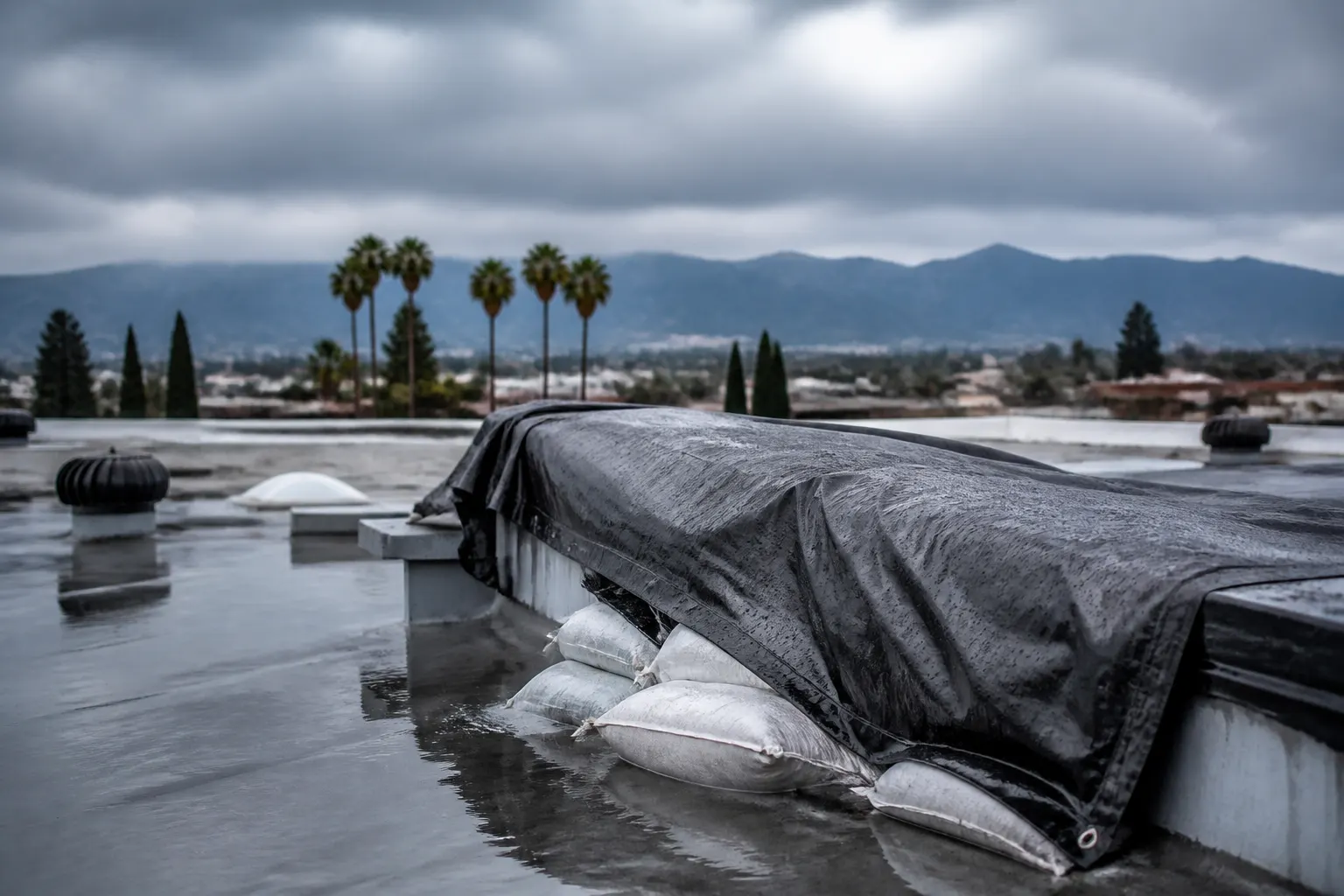
If you have safe access to the roof during daylight hours and dry conditions, you might be able to apply temporary external protection. Emergency roof repair tarps, available at most hardware stores, can be secured over the leak area using sandbags or weighted objects - never nails or screws that could create additional penetrations. However, this should only be attempted by experienced maintenance personnel and never during storms, high winds, or on steep slopes.
Consider the unique challenges that commercial roofs present. Many commercial buildings in Alhambra and throughout Los Angeles County feature flat or low-slope roofs that can accumulate standing water, making leak identification and temporary repairs more complex. If water is ponding in areas away from the original leak, you may be dealing with a drainage issue that’s exacerbating the problem.
For businesses with sensitive equipment or inventory, create a priority protection plan. Move high-value items first, then focus on protecting items that could create secondary damage if wet, such as cardboard packaging or paper products that might dissolve and clog drains.
Understanding Emergency Response Times and Availability
Setting realistic expectations about emergency response times helps reduce stress and allows for better planning during a roof leak situation. HP Roofing Pro provides same-business-day response across LA County, the Inland Empire, and San Diego for emergency roof leak repair calls. Our standard hours are Monday through Friday, 7:00 am to 4:30 pm - after-hours requests are answered the same business day. Reach us directly at 909-521-1285.
Weather conditions significantly affect response across the region. During major storms affecting greater Los Angeles, emergency contractors may be handling multiple calls simultaneously. LA area weather patterns - including Santa Ana wind events and seasonal rain storms - can create sudden spikes in emergency calls. Contacting your contractor as early as possible in the event gives them the best opportunity to mobilize quickly.
Geographic location also plays a role. Properties in central areas like Alhambra, Pasadena, and the San Gabriel Valley typically see faster access than those in more remote locations. HP Roofing Pro operates out of Alhambra and serves the full LA Basin, San Gabriel Valley, and Inland Empire with a full crew and equipment - not a referral network.
The nature of your emergency affects prioritization. Contractors triage calls based on safety risks and damage potential. A leak threatening electrical systems or causing structural concerns receives priority over smaller, well-contained leaks. Active water intrusion in occupied spaces also receives expedited response compared to leaks in unoccupied storage areas.
When you call 909-521-1285, provide complete information to help us prioritize and prepare. Describe the leak size, location, affected areas, safety concerns, and current containment efforts. This allows us to bring appropriate equipment and materials and give you a more accurate response timeline.
Evaluating Emergency Contractors: What to Look for Under Pressure
When you’re dealing with an active roof leak in Los Angeles, the pressure to accept help from any available contractor can be real. However, making hasty decisions about emergency repairs can lead to bigger problems and higher costs. Even in a crisis, take a moment to verify contractor credentials.
Legitimate emergency roofing contractors should provide immediate proof of proper licensing and insurance. In California, contractors must hold a valid CSLB license for commercial roofing work. HP Roofing Pro holds CSLB License #1043546 (C-39) and is licensed, insured, and bonded. Don’t hesitate to ask any contractor for their license number and insurance certificate - reputable contractors expect these requests and provide documentation readily.
Be cautious of contractors who appear unsolicited at your property, especially those claiming to be “in the neighborhood” or offering immediate repairs at unusually low prices. Storm-chasing contractors often target properties with visible damage, offering quick fixes that may void manufacturer warranties or create long-term problems. Work instead with established local contractors who have demonstrated expertise in commercial roof emergency situations.
Ask about their emergency repair approach and what permanent repair options they’ll recommend once the immediate situation is stabilized. Quality contractors explain their temporary stabilization methods and provide clear timelines for permanent repairs. They should also help coordinate with your insurance company and document damage for claims purposes.
HP Roofing Pro follows an honest, inspection-first approach: repair when possible, restore with our seamless coating system when the roof needs more support, and recommend replacement only when it’s genuinely necessary. We provide written pricing for every viable option - so you know exactly what you’re approving before any work begins.
Working with Insurance: Documentation and Claims Management
Effective insurance claims for emergency roof leak repair in Los Angeles start with the documentation you gathered in those first thirty minutes - and continue through every step of the repair process. Property managers who treat documentation as an ongoing responsibility rather than a one-time task consistently see smoother claims outcomes.
Keep a running log from the moment the leak is discovered: timestamps, photographs, videos, written descriptions of affected areas, and records of every containment measure you implemented. Note the names of anyone who observed the damage, including tenants, maintenance staff, and contractors. This contemporaneous record is more credible to adjusters than accounts assembled after the fact.
When your roofing contractor arrives, ask them to provide a written assessment of the damage and the recommended scope of repairs. HP Roofing Pro provides written pricing for every viable repair option - this written documentation supports your claim and ensures there are no surprises on either side. We can work alongside your adjuster or insurance representative to ensure the damage assessment is complete and accurately reflects what we find on the roof.
Understand the difference between emergency stabilization costs and permanent repair costs. Insurance policies treat these differently, and your adjuster will want a clear breakdown. Reputable contractors separate temporary mitigation work from permanent repairs in their documentation, making it easier for you to submit a complete and organized claim.
Finally, retain all receipts for any materials you purchased for temporary containment - tarps, buckets, plastic sheeting. These out-of-pocket costs are often reimbursable under commercial property policies when properly documented.
Prevention: Building Emergency Response Plans Before You Need Them
The best emergency roof leak response starts long before any water comes through the ceiling. Property managers who maintain documented emergency plans and regular roof inspection schedules are consistently better positioned to minimize damage, control costs, and keep tenants informed when a leak does occur.
Start with a free roof assessment from a licensed contractor. HP Roofing Pro provides free inspections for commercial properties across Los Angeles, the San Gabriel Valley, and the Inland Empire - call 909-521-1285 or visit estimate.hproofingpro.com/commercial-quote to schedule. A professional assessment identifies areas of existing vulnerability: failing seams, ponding water zones, aging flashings, and penetrations around HVAC equipment or skylights. Addressing these proactively is nearly always less expensive than emergency repairs after a leak develops.
Document your roof’s current condition thoroughly. Photographs taken during an inspection become a baseline reference that makes future damage assessments more straightforward. Ask your contractor for a written report that you can keep on file and share with your insurance carrier.
Build a simple emergency contact list and keep it accessible to your entire property management team - not just the senior manager. Include your roofing contractor’s number (HP Roofing Pro: 909-521-1285), your insurance carrier’s claims line, your property’s utility emergency contacts, and your list of tenants with contact information. When a leak happens at 11 pm on a Tuesday, the person on duty should be able to act immediately without hunting for numbers.
Routine maintenance is the most reliable form of emergency prevention. Many commercial roofs in Alhambra and throughout Los Angeles County can be repaired or restored rather than replaced - particularly flat and low-slope systems that are common across LA Basin warehouses, HOA complexes, and medical facilities. HP Roofing Pro’s seamless cool-roof coating system can seal existing roofs with a leak-free warranty and without requiring a tear-off or interrupting operations in occupied buildings. Restoration typically costs significantly less than full replacement - and it starts with an honest assessment of what your roof actually needs.
Conclusion
Emergency roof leak repair in Los Angeles doesn’t have to become a full-scale property loss. Property managers who act quickly, document thoroughly, and work with licensed, accountable contractors navigate these situations with far better outcomes than those who are caught without a plan.
HP Roofing Pro serves commercial property owners and managers across Los Angeles, the San Gabriel Valley, Alhambra, Pasadena, the Inland Empire, and beyond. We hold CSLB License #1043546, carry full insurance and bonding, and provide same-business-day emergency response across LA County. Our approach is straightforward: honest assessment, written options, and repairs that last - not the fastest patch that gets us to the next job.
If you’re dealing with an active leak or want to assess your roof before the next storm season, call us at 909-521-1285 or request a free inspection at estimate.hproofingpro.com/commercial-quote. We’ll tell you what your roof actually needs.