Blog
Flat Roof Ponding Water on LA Commercial Buildings: What It Actually Means and When It Becomes a Structural Problem
July 7, 2026
Flat Roof Ponding Water on LA Commercial Buildings: What It Actually Means and When It Becomes a Structural Problem
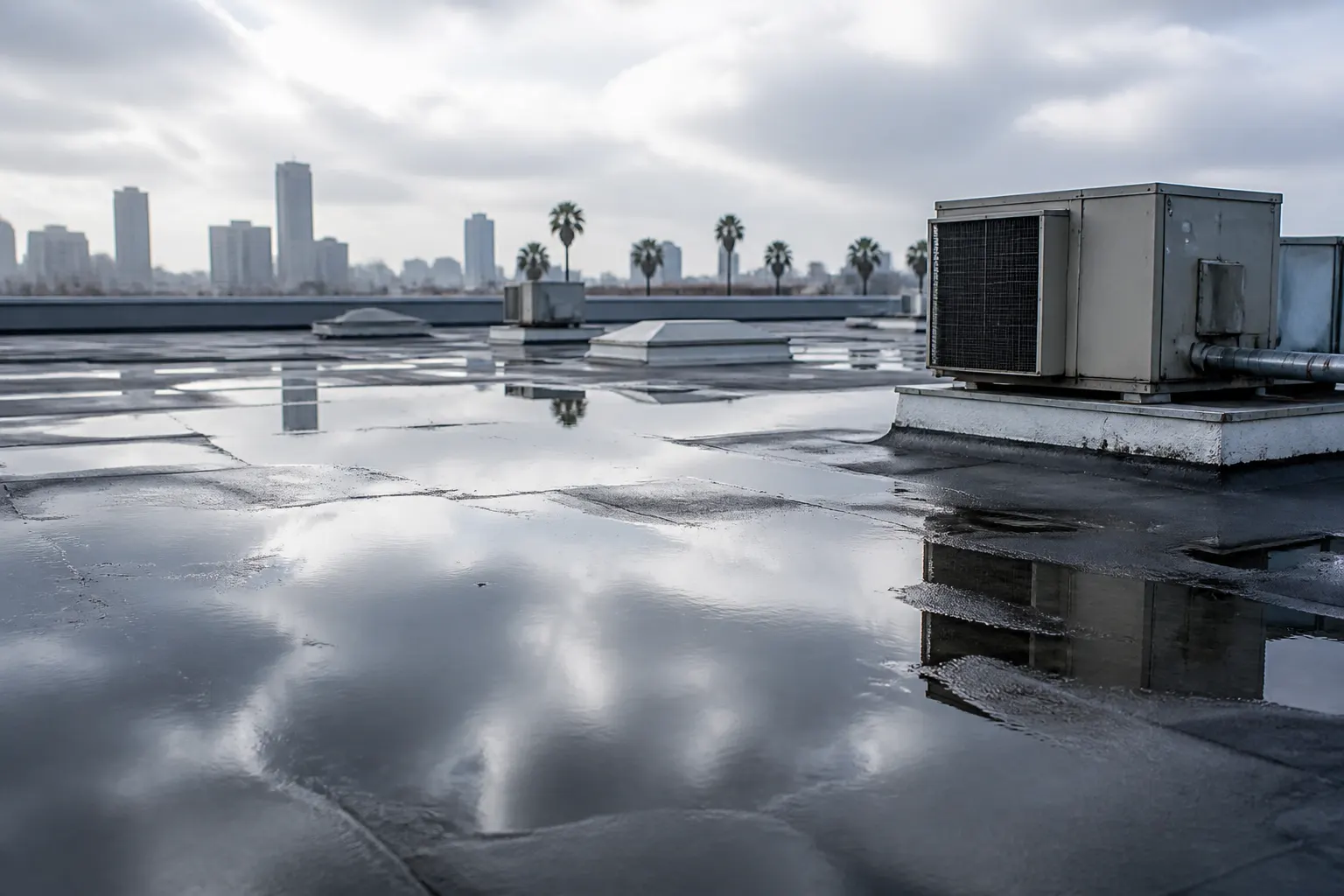
If you manage commercial property in the Los Angeles area, you have almost certainly stepped onto a flat roof after a winter storm and found standing water that had no intention of leaving. For most property managers, the immediate question is the same: is this normal, or is something wrong? Ponding water on flat roofs in Los Angeles is one of the most common concerns we hear from building owners across the San Gabriel Valley and the LA Basin, and the honest answer is that it depends entirely on how long the water stays, where it collects, and what condition the roof membrane is in underneath it. This article gives you a practical framework for reading what that standing water is actually telling you.
What “Ponding” Actually Means (and What It Does Not)
The roofing industry defines ponding water as water that remains standing on a flat or low-slope roof for more than 48 hours after rainfall has stopped. That 48-hour window matters. Most well-maintained flat roofs will hold some water after heavy rain simply because the drainage system cannot clear everything instantly. A roof that dries out within a day or two, with no recurring low spots, is not a ponding problem. It is normal drainage lag.
True ponding is a pattern, not an event. If the same area of your roof holds water after every rain, if that area is visibly lower than the surrounding surface, or if you can see a defined “bowl” shape when you walk the roof on a dry day, you are looking at a drainage issue that deserves a real assessment.
In Southern California, the stakes are a bit different than in wetter climates. We do not get year-round rainfall, which means a drainage problem can go undetected for months between storm seasons. By the time the next rain arrives, a minor low spot can have become a significant structural concern.
Why Flat Roofs in the San Gabriel Valley Are Particularly Vulnerable
Commercial flat roofs in the Alhambra area and across the San Gabriel Valley were built across several different eras, and the drainage design assumptions of those eras do not always hold up today. Many mid-century commercial buildings were designed with interior drains as the primary drainage system, with scuppers as overflow only. When those interior drains clog or their drain bowls compress over time, the roof has no efficient way to shed water.
A few specific failure points show up repeatedly in this region:
Compressed insulation beneath the membrane. When water ponds and is absorbed through any membrane breach, the insulation below compresses and loses its shape. This creates a permanent low spot that collects more water in the next storm, which compresses the insulation further. It is a self-reinforcing cycle that worsens with every rain season.
Parapet walls and crickets. Many older commercial buildings in this area have low parapet walls with scuppers that were never properly flashed or have since shifted. Water that cannot reach the scupper level simply pools until it evaporates or finds a way through the membrane.
Drain collars and clamping rings. Interior flat roof drains have a clamping ring that holds the membrane in place and creates a watertight seal at the drain opening. When those rings loosen or corrode, the seal fails precisely where water is most concentrated. This is one of the most common sources of ceiling leaks in commercial buildings throughout Los Angeles County.
Rooftop equipment pads. HVAC units, condensers, and other mechanical equipment create micro-dams when they are improperly flashed or when the curbs they sit on have settled. Water backs up behind equipment pads and sits long after the rest of the roof has dried.
When Ponding Becomes a Structural Problem
Ponding water does not become a structural issue overnight. It becomes one through consistent repetition over multiple storm seasons, combined with any membrane failure that allows moisture to reach the structural deck below.
The weight of water is often cited as the primary risk, and it is real. One inch of standing water across a 10,000-square-foot roof adds roughly 520,000 pounds of load to the building’s structure. Most commercial buildings are engineered with some margin for this, but older buildings may have decks that have already been weakened by prior moisture intrusion. Combined loading, a deck already compromised by rot or corrosion plus the added weight of a ponding event, is where structural risk becomes concrete rather than theoretical.
The more common path to serious damage is slower. Water sitting against a membrane seam for 48 to 72 hours will eventually find its way through, particularly in an aging modified bitumen or built-up roof system. Once it penetrates the membrane, it travels horizontally through the insulation layer and may not show up as an interior ceiling leak for weeks or months. By the time the leak is visible inside the building, the substrate damage is often significant.
For property managers overseeing multiple buildings, understanding which roofs have the greatest risk exposure is an asset management question, not just a maintenance question. A comprehensive guide to flat roof maintenance for businesses can help you build that risk picture systematically across your portfolio.
The Inspection-First Framework: Repair, Restore, or Replace
Not every ponding situation calls for the same response. The correct answer, whether that is a targeted repair, a full restoration, or a roof replacement, comes from a systematic inspection that looks at three variables: drainage capacity, membrane condition, and deck integrity.
Step 1: Evaluate drainage capacity. Walk the roof after a dry period and look for visible low spots, debris accumulation in drain bowls, and scuppers that are blocked or undersized. A drain that is physically clear but sitting in a compressed area of insulation will still pond. Drainage restoration alone, clearing drains and adding tapered insulation crickets to redirect flow, resolves a significant percentage of ponding issues.
Step 2: Assess membrane condition. An experienced contractor will probe soft spots, check seam integrity, and use either infrared scanning or nuclear moisture testing to identify where water has already migrated below the surface. Localized membrane damage over a structurally sound deck is the best-case scenario. It typically supports expert flat roof repair rather than full replacement.
Step 3: Evaluate deck integrity. This is where the cost calculus shifts dramatically. A metal deck showing signs of corrosion or a wood deck with measurable deflection changes the project from a repair or restoration to a replacement conversation. This assessment usually requires probing or cutting test patches to inspect below the membrane and insulation layers.
If the membrane is aged but the deck is sound, restoration is often the most cost-effective path. Our RainArmor seamless cool-roof system is specifically designed for this scenario, applying a seamless elastomeric membrane over the existing assembly to address drainage and waterproofing simultaneously without the cost and disruption of a full tear-off.
What Property Managers Should Document Before Calling a Contractor
One of the most useful things you can do before scheduling an inspection is to build a short documentation file for each roof on your portfolio. This takes less than an hour per building and makes every contractor conversation more productive.
Collect the following:
- The age of the current roof system and any documentation of prior repairs or overlays
- Photos from at least two recent rain events showing where water collects and how long it remains
- Any existing inspection reports or moisture survey results
- Records of interior leak events, including date, location, and whether the leak was traced to the roof or another source
This documentation gives a qualified inspector a starting point and prevents you from relying solely on a visual assessment that may miss subsurface moisture migration.
For buildings in the Alhambra area and the broader San Gabriel Valley, scheduling an inspection before the November-through-March storm season is the most practical timing. Waiting until active rain is creating active leaks puts you in emergency repair territory, where options narrow and costs rise. A structured commercial roof maintenance schedule aligned to the Southern California rain season is the most reliable way to stay ahead of this.
How Southern California’s Climate Creates Specific Risk Patterns
It is worth addressing one assumption that causes property managers to underestimate ponding risk in this region: because Southern California is generally dry, some owners assume that drainage problems are less urgent here than in rainy climates. The opposite can be true.
Concentrated winter rainfall, especially atmospheric river events of the kind that have hit the LA Basin with increasing frequency, can deliver several inches of rain over 24 to 48 hours. A roof that has been sitting through eight months of dry weather is more likely to have accumulated debris in drains, more likely to have had minor cracks seal temporarily from heat and UV, and more likely to have drainage hardware that has not been exercised in months. When the storm arrives, everything that has been quietly degrading gets tested at once.
UV exposure compounds the problem. The same intense sunlight that makes the region attractive also accelerates membrane aging. A modified bitumen membrane that might last 20 years in Seattle may show surface degradation at year 12 in Los Angeles. Our commercial roofing services across Los Angeles County reflect this reality, with inspection protocols calibrated to SoCal’s specific exposure conditions rather than national averages.
A Practical Risk-Level Assessment
Before you call a contractor, you can assign a rough risk level to a ponding situation using three questions:
-
Does the water clear within 48 hours of rain stopping? If yes, the risk is low. Monitor and document but do not escalate immediately.
-
Does the same area pond after every rain event, regardless of storm intensity? If yes, you have a drainage or substrate problem that warrants a professional inspection.
-
Have you had any interior leaks in the 12 months following a rain event, even minor ones? If yes, the ponding area and the interior leak should be investigated as potentially connected, and the inspection should prioritize moisture testing below the membrane.
A risk level that falls into category two or three benefits from preventive commercial roof maintenance rather than a wait-and-see approach. Intervening before structural damage occurs almost always costs less than addressing it afterward.
Take the Next Step Before Storm Season Hits
Ponding water on a flat roof is not automatically a crisis, but it is always information. It is the roof telling you that drainage, membrane, or substrate conditions need attention before the next storm tests them again. The property managers who handle this well are the ones who inspect proactively, document consistently, and engage qualified contractors before conditions deteriorate.
HP Roofing Pro is based in Alhambra, CA and serves commercial property owners and facilities managers throughout the San Gabriel Valley, the LA Basin, and the surrounding region. Our inspection process covers drainage capacity, membrane condition, and deck integrity, giving you a clear picture of where your building stands and what the appropriate next step actually is.
Contact HP Roofing Pro today to schedule a pre-storm season flat roof inspection and get a straight answer about what the water on your roof is actually telling you.