Blog
Medical Office and Healthcare Facility Roofing in Los Angeles: Why Leak Prevention and Contractor Accountability Matter More Than Cost
June 26, 2026
Medical Office and Healthcare Facility Roofing in Los Angeles: Why Leak Prevention and Contractor Accountability Matter More Than Cost
A single roof leak in a medical office or clinical setting can set off a chain of consequences that no facilities director wants to manage on a Tuesday morning. Water infiltration near electrical panels, exam rooms, or sterile supply areas does not stay contained to a maintenance ticket, it escalates into patient care disruptions, infection control concerns, regulatory scrutiny, and liability exposure that can dwarf the cost of the repair itself. For healthcare facility managers responsible for buildings across LA County, medical facility roofing in Los Angeles demands a fundamentally different standard of evaluation than most commercial properties. The stakes are simply higher, and the margin for error is narrower.
This article is written for the facilities director or operations manager who already understands that cost is a factor, but knows it cannot be the only factor. If you’re responsible for a medical office, outpatient clinic, surgical center, or multi-tenant healthcare building, here’s what you should be prioritizing.
Why Healthcare Buildings Are a Different Category of Roofing Risk
Most commercial roofs protect inventory, equipment, or office space. A leak is disruptive and costly, but the downstream consequences are usually manageable. In healthcare settings, the risk profile changes significantly.
Water intrusion in a clinical environment can compromise sterilized equipment, create mold conditions in spaces where immunocompromised patients receive care, and trigger inspection findings from accreditation bodies like The Joint Commission or the California Department of Public Health. Beyond the clinical risks, wet ceilings in patient areas create immediate slip-and-fall liability, while damage to imaging equipment or server rooms can produce repair and replacement costs that run into six figures.
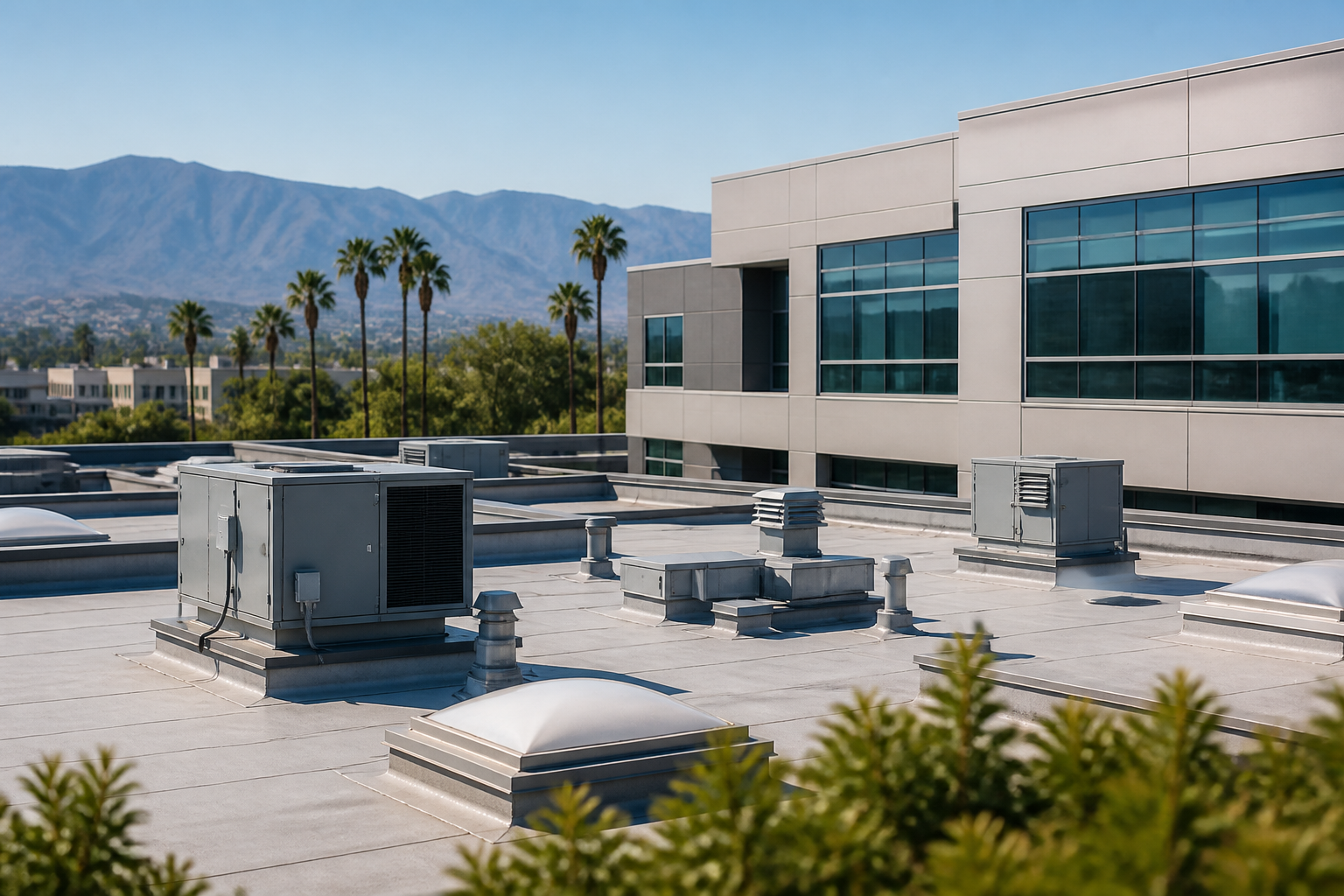
The flat and low-slope roof systems common to medical office buildings and outpatient facilities, TPO, PVC membrane, modified bitumen, are durable and well-suited to Southern California’s climate when properly installed and maintained. The problem is not the material. The problem is deferred maintenance, inadequate contractor documentation, and the assumption that a roof that isn’t visibly failing is a roof that’s performing.
For facilities managers overseeing properties across the San Gabriel Valley and greater LA County, this assumption is particularly dangerous. Seasonal rainfall is concentrated in a short window, and roofs that held through a dry stretch can fail quickly under the first significant precipitation event of the year.
Leak Prevention Starts Long Before It Rains
The most effective leak prevention strategy is one that happens in September, not in January when water is already coming through the ceiling. Preventive commercial roof maintenance, conducted on a scheduled, documented basis, is the single most reliable way to protect a healthcare facility from unplanned water intrusion.
A proper pre-season maintenance visit for a medical facility roof should include:
- Membrane inspection, checking for punctures, seam separations, blistering, and areas of ponding water that indicate drainage issues
- Flashing assessment, examining perimeter edge metal, equipment curbs, HVAC penetrations, and drain collars, which are the most common points of failure on flat commercial roofs
- Drain and gutter clearing, ensuring downspouts and interior drains are unobstructed before the rainy season
- Documentation with photos, creating a timestamped record of existing conditions that protects the facility manager and creates accountability for the contractor
That last point deserves emphasis. In a healthcare setting, documentation is not optional, it is how you demonstrate due diligence if a regulatory body or insurance carrier asks what preventive measures were in place before an incident occurred.
For a deeper look at building a structured approach, the commercial roof maintenance schedule for preventing costly emergency repairs provides a practical framework that healthcare facilities can adapt to their inspection cadence.
What Contractor Accountability Actually Looks Like
The phrase “contractor accountability” gets used loosely, but for a facilities director, it should have a specific meaning: the contractor maintains a documented record of every visit, every finding, every repair, and every warranty-relevant condition, and that record is accessible to you at any point.
This matters for several reasons that are specific to healthcare operations.
Insurance and risk management. When a claim is filed, your carrier will want to know the maintenance history of the roof. A contractor who keeps organized records, and provides copies to the client after every visit, gives you the documentation trail that supports your claim and demonstrates responsible stewardship of the property.
Regulatory compliance. California’s health facility licensing environment expects that building systems are maintained to manufacturer and code standards. A roofing contractor who cannot produce inspection records, material specifications, or warranty documentation is a liability in an audit environment.
Transition protection. Healthcare facilities often change management companies or building owners. Without thorough records, the incoming team has no baseline, and inevitably ends up spending more in the first year to assess conditions that should have been documented already.
When evaluating commercial roofing contractors for a healthcare property, ask specifically: What do you provide after each service visit? How is documentation stored and shared? A contractor who cannot answer that question clearly is telling you something important about how they operate.
For guidance on evaluating contractors more broadly, how to choose a licensed commercial roofing contractor in California outlines the CSLB licensing verification steps and vetting criteria that matter most in the LA County market.
Understanding Warranty Terms Before You Sign Anything
Roofing warranties are frequently misunderstood, and the misunderstanding tends to surface at the worst possible moment. There are two distinct types of warranty coverage that healthcare facility managers should understand before any roofing work begins.
Manufacturer’s material warranty covers defects in the roofing material itself, membrane failures, coating delamination, and similar product-level issues. These warranties are issued by manufacturers like Firestone, GAF, or Carlisle, and they typically range from 10 to 30 years depending on the system and installation tier.
Contractor workmanship warranty covers installation errors, improperly sealed seams, incorrectly flashed penetrations, or membrane that was not adhered per specification. This warranty is issued by the roofing contractor, and its value depends entirely on the contractor still being in business and honoring their commitments.
The distinction matters because a leak caused by poor installation will not be covered under a manufacturer’s material warranty. Many facility managers discover this the hard way.
When reviewing warranty terms for a healthcare facility, look for:
- No-dollar-limit (NDL) warranties for large projects, which cap the manufacturer’s liability at no cost to the building owner
- Specific exclusions, read them carefully, as most warranties exclude damage caused by deferred maintenance, which circles back to the importance of documented service records
- Transferability, critical if the property may change ownership or management
HP Roofing Pro’s approach to warranty coverage is outlined on the HP Roofing Pro warranties page, including what manufacturer-backed coverage looks like for different commercial roofing systems.
The Cost Calculation Healthcare Facilities Should Actually Be Making
There is a version of the cost conversation that makes sense, and a version that creates expensive problems later. The version that makes sense accounts for the full cost of a roof failure in a clinical setting, not just the repair invoice.
When a medical office in Alhambra, CA loses ceiling tiles and suffers drywall damage in an exam room, the direct repair cost might be $8,000. But add the cost of rescheduled appointments, infection control assessment, temporary relocation of clinical operations, and the time spent by administrative and facilities staff managing the incident, and the total loss is substantially higher. If the leak triggers a Joint Commission finding or a complaint to CDPH, the downstream compliance costs can be higher still.
The right cost calculation compares the annualized cost of a preventive maintenance program against the probability-weighted cost of an unplanned failure event. For most medical facilities with flat or low-slope roofs in the LA County climate, that calculation favors investment in maintenance and qualified installation by a meaningful margin.
This is also why the contractor selection process for healthcare facilities should weight experience with commercial healthcare buildings heavily. A contractor who has worked on medical office buildings and outpatient clinics in markets like the San Gabriel Valley understands the access constraints, the operational sensitivity, and the documentation requirements that general commercial contractors may not.
For healthcare properties considering whether their current roof system is worth maintaining or whether restoration or replacement is the better path, our commercial roofing services in Los Angeles County page covers the range of options available to LA area property owners and facility managers.
How to Evaluate a Roofing Contractor for a Healthcare Property
Here is a working checklist for facilities directors evaluating commercial roofing contractors for medical office or clinical buildings in LA County:
Licensing and insurance
- Verify active CSLB license (contractor should provide license number voluntarily)
- Confirm general liability and workers’ compensation coverage specific to commercial roofing
- Request certificates of insurance naming your facility as additional insured
Healthcare-specific experience
- Ask for references from medical office buildings, outpatient clinics, or hospital-adjacent facilities
- Inquire about experience working in occupied clinical environments with access restrictions
- Confirm familiarity with infection control requirements during roofing work
Documentation practices
- Request a sample post-visit report to understand what they actually deliver
- Ask how warranty documentation is organized and provided to the client
- Confirm that any repair work will be photographed and documented before and after
Maintenance program structure
- Evaluate whether they offer scheduled maintenance agreements or only respond to service calls
- Ask what their inspection protocol includes for healthcare-specific penetrations (medical gas lines, HVAC equipment, rooftop access points)
Financial stability
- For long-term maintenance relationships, the contractor’s business longevity matters, a workmanship warranty from a company that closes in two years has no value
Based in Alhambra, CA, HP Roofing Pro serves medical office buildings and healthcare facilities throughout LA County and the San Gabriel Valley. Our commercial roof repair services and preventive maintenance programs are structured around the documentation and accountability standards that healthcare facility managers require, not as an add-on, but as the baseline expectation for every project.
Protecting Your Facility Starts With the Right Partner
Healthcare facilities in Los Angeles operate in an environment where a roof that merely keeps out most of the rain is not sufficient. The combination of regulatory oversight, patient care obligations, and liability exposure means that your roofing program needs to be proactive, documented, and executed by a contractor who understands what’s at stake inside the building.
From our base in Alhambra, CA, we work with facilities directors and operations managers across the greater LA area who are done reacting to roof problems and ready to get ahead of them. Whether you manage a single medical office building or a portfolio of healthcare properties across the San Gabriel Valley and LA County, we bring the contractor accountability and documentation standards that the healthcare environment demands.
Contact HP Roofing Pro today to schedule a comprehensive roof assessment for your medical or clinical facility. We’ll evaluate your current roof condition, review your maintenance history, identify the highest-priority vulnerabilities, and provide a clear, documented plan, so you can make informed decisions before the next rain season, not after it.
HP Roofing Pro is a licensed commercial roofing contractor headquartered in Alhambra, CA, serving healthcare facilities, medical offices, and commercial properties throughout Los Angeles County and the San Gabriel Valley.