Blog
Residential Roof Coating in Los Angeles County: What Homeowners Should Know Before They Compare It to Full Replacement
July 2, 2026
Residential Roof Coating in Los Angeles County: What Homeowners Should Know Before They Compare It to Full Replacement
If your roof is showing its age and you have started getting estimates, you already know the sticker shock that comes with a full tear-off and replacement. For many homeowners in LA County, that number lands somewhere between $15,000 and $30,000 or more depending on the size and pitch of the home. It is no surprise that searches for residential roof coating Los Angeles have climbed steadily as people look for alternatives that are honest, not just cheaper. But the information online is scattered, often written by people trying to sell you something, and rarely explains when a coating actually makes sense versus when replacement is the only real answer. This article is written to close that gap.
HP Roofing Pro is based in Alhambra, CA and has spent years applying commercial-grade elastomeric systems to flat and low-slope commercial roofs across Los Angeles County. The Residential roof Coating offering takes that same commercial methodology and applies it to qualifying shingle roofs on single-family homes. That distinction matters, and we will explain why throughout this article.
What a Roof Coating Actually Is (and What It Is Not)
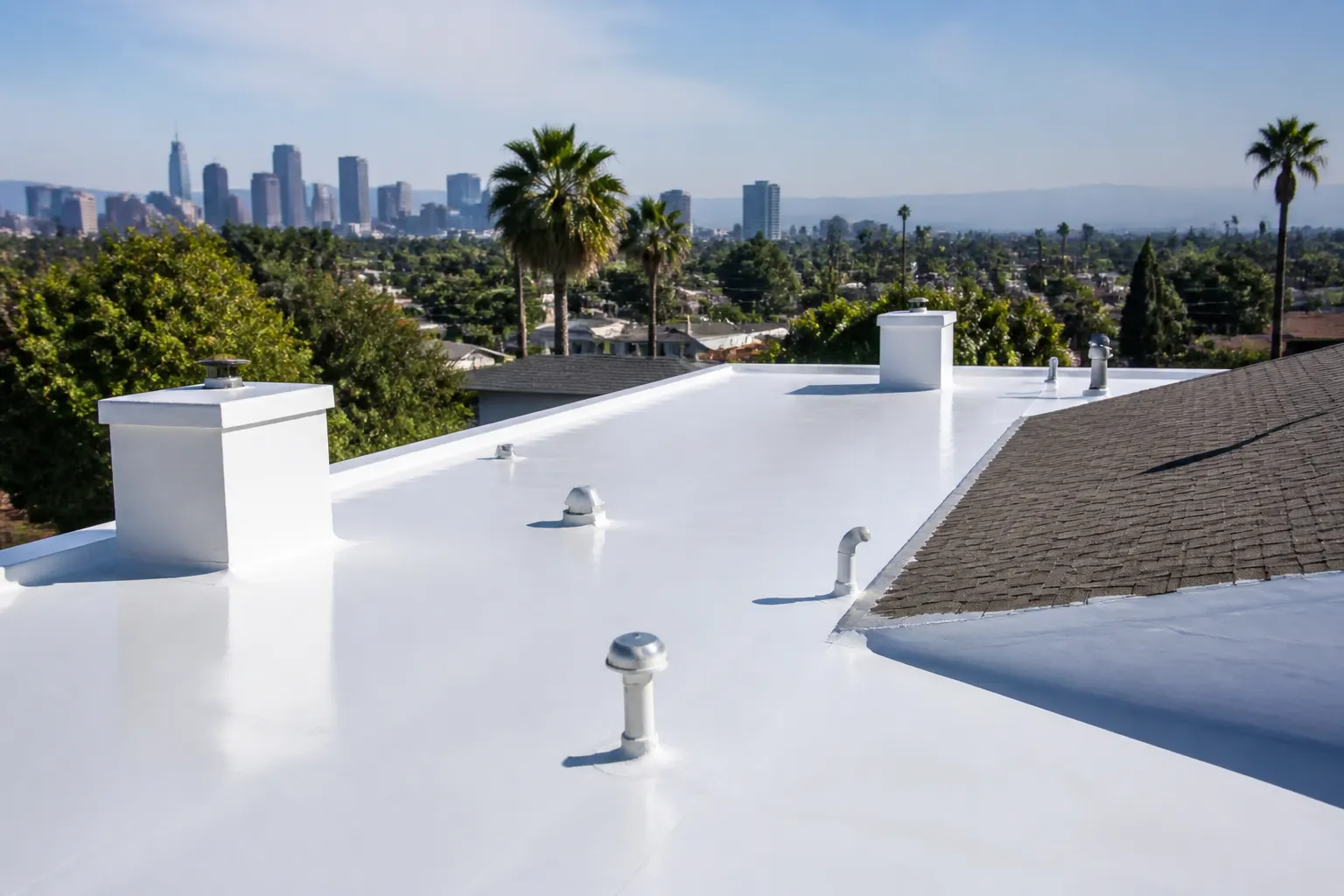
A roof coating is not a paint. It is not a temporary patch. At the commercial-grade level, an elastomeric coating is a thick, flexible membrane that bonds directly to the existing roof surface and cures into a continuous, seamless layer. The product used in HP Roofing Pro’s residential program is an acrylic-based elastomeric formula, the same chemistry class used on commercial flat roofs to reflect heat, prevent water intrusion, and extend service life by 15 years or more.
You can read a much deeper breakdown of how these systems work in this elastomeric coatings guide, but the short version is this: the coating stretches and recovers with your roof as temperatures change, rather than cracking the way rigid materials do. In Southern California, where rooftop temperatures can hit 160 degrees Fahrenheit in summer, that flexibility is not a marketing point. It is a structural requirement.
What a coating is not: a fix for a structurally compromised roof deck, for active rot, or for damaged flashing that has never been properly addressed. The coating seals the surface. It does not reinforce sheathing that has gone soft, and it does not replace missing or curled shingles on a roof that has already failed in multiple places.
How HP Roofing Pro Assesses Whether Your Shingle Roof Qualifies
The assessment process is the most important step, and it is where the honest conversation either happens or does not. Before any coating is applied, a trained technician walks the roof and evaluates several factors.
Shingle condition. Coating works best on shingles that are still structurally sound but weathered. If granule loss is significant but the mat underneath is intact, a coating can encapsulate and protect what remains. If shingles are curling at the edges, cracked through, or breaking apart at the corners, the coating has nothing solid to bond to.
Roof deck integrity. The technician will probe areas around penetrations, valleys, and low-slope sections for soft spots that indicate moisture in the decking. A soft deck under a new coating is a problem waiting to get worse.
Existing leak history. If the homeowner reports interior staining or active leaks, the source has to be identified and addressed before any coating goes down. Coating over an active leak does not fix the leak. It hides it, which makes future diagnosis far more expensive.
Slope and drainage. Elastomeric coatings are well-suited to low-slope sections of residential roofs, which is common on ranch-style homes and additions throughout the San Gabriel Valley. Very steep pitches present adhesion and pooling risks that affect long-term performance.
If the roof does not pass assessment, the honest answer is replacement. This is something the team at HP Roofing Pro will tell you directly, even though it means referring the work elsewhere. A coating applied to a failing roof is not a service. It is a liability.
The Application Process: What to Expect on Your Property
For a qualifying shingle roof, the application process typically spans one to two days depending on roof size and weather conditions. Here is what it looks like in plain terms.
The roof is first cleaned thoroughly to remove dirt, biological growth, and loose granules. Any shingles that are cracked but still bonded are secured before coating begins. Penetrations (vents, pipe boots, flashing edges) are detailed with a reinforcing fabric and base coat layer to ensure those high-risk areas are fully sealed.
The elastomeric coating is then applied in two passes to reach the required dry mil thickness. That thickness specification is not cosmetic. It is what allows the coating to bridge minor surface irregularities and maintain flexibility over time. A thin application might look the same from the ground, but it will not perform the same under years of thermal cycling and UV exposure.
The final surface is white or light-colored, which brings an energy efficiency benefit that is worth mentioning. Reflective roof coatings are a cornerstone of commercial cool roof systems in California, and the same physics apply at the residential scale. Homeowners in Alhambra and neighboring communities like Monterey Park and San Gabriel often see meaningful reductions in cooling load during peak summer months after the coating is installed.
Shingle Roof Coating vs. Replacement: An Honest Cost Comparison
The cost difference between a qualifying coating and a full tear-off replacement is significant, but it should not be the only factor in your decision. Let’s look at both scenarios clearly.
Full tear-off replacement. A standard asphalt shingle replacement on a 2,000 square foot home in Los Angeles County runs roughly $18,000 to $28,000 at 2024 pricing, depending on pitch complexity, disposal costs, and the shingle tier you choose. The new roof typically carries a manufacturer warranty of 25 to 30 years, though many of those warranties have installation and maintenance conditions attached.
Elastomeric coating. A commercial-grade elastomeric coating on the same roof runs considerably less, and comes with HP Roofing Pro’s 15-year leak-free warranty. That warranty is not a manufacturer’s limited warranty passed through a distributor. It is a workmanship and performance guarantee tied to the application itself.
The honest framing of this comparison is that the coating is not a permanent roof. It buys you 15 well-protected years and defers the larger capital expense. For a homeowner who is five years into a tight mortgage, planning to sell within a decade, or dealing with a roof that still has sound structural bones, that math often makes real sense. For a homeowner whose roof deck has already seen water damage, or whose shingles are at end of life across the entire surface, replacement is the right answer and no one at HP Roofing Pro will pretend otherwise.
If you want to understand what full replacement planning looks like when it becomes necessary, this resource on shingle roof coating vs replacement decisions covers the broader material landscape in Southern California’s climate.
The Commercial Expertise Difference: Why It Matters for Homeowners
Most contractors who offer residential roof coatings learned the product through the residential channel, applying consumer-grade coatings at thin mil thicknesses with short warranty periods. HP Roofing Pro came to residential coating from the opposite direction.
The team’s foundation is in commercial work, specifically the seamless coating systems applied to commercial buildings across the region, from the San Gabriel Valley to greater LA County. Commercial roofing tolerates no margin for error. A warehouse roof failure affects inventory, operations, and liability in ways that make a residential leak look manageable by comparison. That standard, applied to a homeowner’s shingle roof, means a more rigorous assessment, more precise application specifications, and a warranty backed by a contractor who has the volume and reputation to stand behind it.
This is not a sales point. It is a relevant distinction when you are comparing quotes from multiple contractors. Ask any roofer you are evaluating what their typical commercial elastomeric project looks like. Ask them what mil thickness they apply and how they verify it. Ask them what happens if a section fails in year 8 of the warranty. The answers will tell you a great deal.
Questions to Ask Before You Sign Anything
Whether you are evaluating HP Roofing Pro or another contractor, these questions protect you regardless of who you hire.
Is the contractor licensed with the California State License Board? You can verify any contractor’s license status on the CSLB website in about two minutes. Working with an unlicensed contractor voids most manufacturer warranties and leaves you unprotected if work is defective.
What is the warranty structure? A genuine 15-year leak-free warranty means the contractor returns and fixes any leak that originates from the coated area at no cost to you for 15 years. If the warranty has a long list of exclusions or requires you to pay for labor after year three, it is not the same product.
What does the assessment include? A legitimate assessment takes 45 minutes to an hour on a 2,000 square foot roof. If someone gives you a quote after a 10-minute walkthrough from the ground, you should ask why.
What product is being applied? Ask for the product data sheet. A commercial-grade elastomeric coating will have documented dry mil thickness, elongation ratings, and reflectance values. If the contractor cannot provide this, that is useful information.
For additional guidance on what to look for when hiring, this article on how to choose a licensed commercial roofing contractor in California walks through the vetting process in detail.
Making a Decision You Can Feel Good About
The goal of this article was never to convince you that a coating is the right answer for your home. It is to give you enough plain-language information to have a real conversation with any contractor you invite onto your roof.
If your home is in Alhambra, Monterey Park, Rosemead, Temple City, or anywhere else in the San Gabriel Valley or greater LA County, and your roof is showing wear but still has structural integrity, a commercial-grade elastomeric coating deserves a serious look. If the assessment reveals that your roof has already crossed the line into structural failure, you will hear that clearly and be pointed toward the right next step, even if it is not a service HP Roofing Pro provides.
That is what informed decision-making looks like in roofing. No urgency tactics, no hiding the situations where replacement is the honest answer, and no coating applied to a roof that will not hold it.
Contact HP Roofing Pro today to schedule a no-pressure assessment for your home in Alhambra or anywhere in Los Angeles County. The assessment is the first step, and it costs you nothing to know where your roof actually stands.