Blog
Roof Repair vs. Roof Restoration: How Los Angeles Building Owners Can Avoid Paying for More Than They Need
June 17, 2026
Roof Repair vs. Roof Restoration: How Los Angeles Building Owners Can Avoid Paying for More Than They Need
You get the call, the inspection, the estimate — and somehow it always seems to end the same way: a contractor standing on your roof telling you it needs to be completely replaced. For property owners and facility managers across Los Angeles County, this scenario has become so familiar it’s practically a cliché. The real question around roof repair vs restoration in Los Angeles isn’t just technical — it’s financial and strategic. Are you being steered toward a $150,000 tear-off when a $60,000 restoration would solve the problem just as effectively? Or worse, is a small repair being sold as a bandage when your building genuinely needs more comprehensive work?
This guide cuts through the sales noise. Whether you’re a seasoned building owner skeptical of contractor upsells or a facilities manager trying to protect a maintenance budget, understanding the practical differences between repair, restoration, and replacement — and knowing which conditions call for which — is the most valuable tool you can have before any contractor sets foot on your property.
The Three Options, Defined Plainly
Before anything else, let’s establish what each term actually means in the field.
Roof repair is targeted intervention. A section of membrane is failing, a flashing has separated, or a drain is backing up. The scope is specific, the disruption is minimal, and the cost reflects that. Good commercial roof repair services address the problem at its source without touching portions of the roof that are functioning properly.
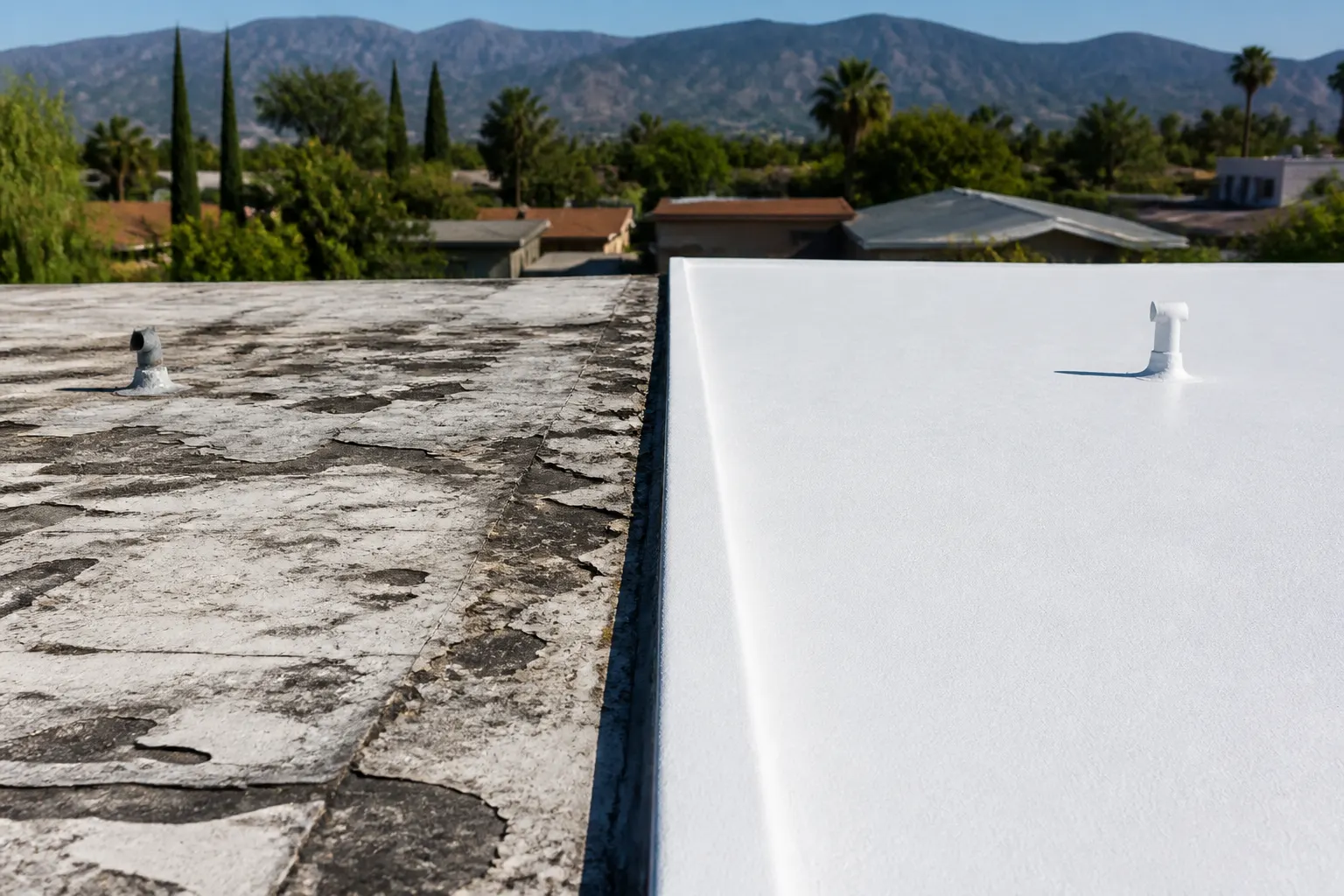
Roof restoration applies a full-coverage system — typically a seamless elastomeric or acrylic coating — over an existing roof that is structurally sound but showing signs of aging, minor surface degradation, or early waterproofing failure. The existing membrane stays in place. The new coating bonds to it, seals it, and extends its service life significantly. HP Roofing Pro’s seamless cool-roof coating system is built specifically for this application — a fully adhered, monolithic barrier that eliminates seams and dramatically reduces leak risk without the disruption of a tear-off.
Roof replacement means the existing system comes off — decking is inspected, any damaged substrate is repaired, and an entirely new roof system is installed from the membrane up. This is the most disruptive, most expensive, and most time-consuming option. It’s also sometimes the right one. But only sometimes.
What Makes a Roof a Repair Candidate vs. a Restoration Candidate
The decision point between repair and restoration often comes down to scope. If the damage is isolated — a single blister, a failed penetration seal, a cracked flashing around an HVAC unit — repair is almost always the correct answer. Paying for a full restoration when 95% of your roof is performing well is unnecessary spending.
Restoration becomes the appropriate choice when degradation is widespread but the underlying structure is still sound. Common indicators include:
- Surface-level cracking or granule loss across a significant percentage of the membrane
- Multiple small leaks appearing in different areas after heavy rain
- A roof system between 10 and 20 years old that has been maintained but is showing consistent signs of aging
- Core samples or moisture scans showing dry insulation and intact substrate beneath a weathered surface
A building owner in Alhambra, CA managing a strip retail center, for example, might have a modified bitumen roof that’s 14 years old, showing widespread surface oxidation and three separate small leaks from the last rainy season. The insulation is dry. The decking is solid. That’s a textbook restoration candidate — not a replacement.
For properties that fall somewhere between these categories, preventive commercial roof maintenance and detailed moisture scanning can provide the documentation needed to make an informed decision rather than an anxious one.
The 40–60% Cost Gap: What It Actually Means for Your Budget
The cost difference between restoration and replacement in the Los Angeles market typically runs between 40% and 60%, sometimes more. On a 20,000-square-foot commercial roof, you might be comparing a $55,000–$75,000 restoration against a $120,000–$160,000 full tear-off and replacement.
That’s not a rounding error. That’s a capital expenditure decision.
For a facilities manager like Marcus, who is accountable to a maintenance budget and a board that scrutinizes every line item, the ability to defer a full replacement by 10–15 years through a properly executed restoration can mean the difference between a project that gets approved this quarter and one that sits in a backlog for two years while the roof continues to deteriorate.
For a property owner like Robert, who has seen enough contractors to know that “this roof needs to be replaced” can sometimes mean “I’m more comfortable quoting what I know,” the financial calculus matters as much as the technical argument. Restoration isn’t a shortcut — when the roof qualifies, it is the professionally correct answer.
It’s also worth noting that restoration with a reflective coating system can qualify under California’s energy efficiency standards. If your property falls under Title-24 requirements, the right restoration system may satisfy compliance obligations that a like-for-like replacement wouldn’t automatically meet. Our commercial cool roof systems are engineered with California’s Title-24 energy code in mind.
When Replacement Is Genuinely the Right Call
Being fair to the process means acknowledging when replacement isn’t just a contractor upsell — it’s the correct recommendation.
Replacement is appropriate when:
- Moisture has infiltrated the insulation layer, meaning the existing system is holding water and a coating applied over it will trap moisture and accelerate failure
- The deck itself is compromised — rotted wood decking, corroded steel, or structurally weakened areas that no surface system can address
- The membrane has failed systemically, not just at the surface — meaning there’s no intact substrate for a coating to bond to
- The roof has already been restored once and is approaching the end of that extended service life, with core samples showing saturated insulation across multiple zones
Infrared moisture scanning and core samples are the diagnostic tools that separate these scenarios from the ones that don’t require replacement. Any contractor recommending a full tear-off without performing — or at minimum commissioning — a moisture scan is skipping a critical step. On commercial roofing services across Los Angeles County, the standard of care includes this diagnostic work before a scope recommendation is made.
If a contractor’s process is to walk the roof visually and immediately quote a replacement, that’s worth noting. Our guide on red flags to watch for with unreliable commercial roofing contractors outlines exactly what the upsell pattern looks like — and what questions to ask before signing anything.
How to Hold an Informed Conversation With Any Contractor
You don’t need a roofing license to ask the right questions. You need a framework.
Before the inspection:
- Ask whether they perform infrared moisture scanning or core sampling as part of their assessment process, and whether there’s a cost for that diagnostic work
- Ask for references from projects where they recommended restoration instead of replacement — a contractor who only does replacements will struggle to answer this
During the estimate review:
- Ask what percentage of the roof surface showed active moisture infiltration in the scan
- Ask what the substrate condition was in the core samples
- Ask specifically why restoration was or wasn’t recommended
When comparing bids:
- Make sure bids are comparing the same scope — a restoration bid and a replacement bid are not apples-to-apples, and it’s worth understanding why each contractor landed where they did
- Ask about warranty terms and what’s covered: a manufacturer-backed warranty on a restoration system is a meaningful data point
For building owners in Alhambra, CA and the surrounding San Gabriel Valley, working with a contractor who services this market regularly means they understand local building stock, typical roof ages, and the specific weathering patterns common to the region. HP Roofing Pro is headquartered in Alhambra, CA and brings that local knowledge to every assessment.
The Decision Framework in Practice
To summarize the decision logic clearly:
| Condition | Right Answer |
|---|---|
| Isolated damage, healthy surrounding membrane | Repair |
| Widespread surface aging, dry substrate, intact structure | Restoration |
| Saturated insulation, compromised deck, systemic failure | Replacement |
| Post-restoration aging, second-cycle assessment needed | Evaluation + Replacement if confirmed |
The goal isn’t to push you toward the cheapest option — it’s to match the scope of work to the actual condition of your roof. Restoration isn’t always appropriate. Neither is replacement. The diagnostic work is what makes the recommendation credible.
Get a Straight Answer on Your Roof
If you’ve been quoted a replacement and you’re not convinced, or if you’re managing a property where a roof decision is coming up and you want to understand your options before any contractor walks the building — that’s exactly the conversation worth having before money changes hands.
HP Roofing Pro serves commercial property owners and facility managers throughout Los Angeles County, the San Gabriel Valley, and greater Southern California. Our assessment process includes moisture diagnostics, not just a visual walk. Our recommendations are scoped to what the roof actually needs.
Contact HP Roofing Pro today for a no-pressure roof assessment. We’ll tell you what we find — repair, restoration, or replacement — and show you the documentation that supports it.
HP Roofing Pro is a licensed commercial roofing contractor headquartered in Alhambra, CA, serving Los Angeles County and surrounding Southern California markets.