Blog
What Causes Flat Roof Leaks on Commercial Buildings in Los Angeles - and How Each One Should Be Fixed
June 29, 2026
What Causes Flat Roof Leaks on Commercial Buildings in Los Angeles, and How Each One Should Be Fixed
You’ve called a roofer. They patched the leak. Three months later, water is dripping onto your merchandise, soaking your ceiling tiles, or pooling near your electrical panel, again. If this sounds familiar, you’re not alone. Flat roof leak causes on commercial buildings are rarely as simple as a single puncture or a worn-out patch of membrane. They’re usually the result of multiple compounding factors, and when a contractor treats a complex problem with a superficial fix, the leak always comes back.
This guide is written for property managers, small-business owners, and first-time facilities decision-makers who are tired of being handed a bill without an explanation. We’ll break down the most common causes of flat roof failure in the Los Angeles climate, explain what’s actually happening beneath the surface, and describe what a proper repair looks like for each scenario, including when a targeted fix is enough and when a broader approach is the only real solution.
Why Flat Roofs in the LA Climate Are Uniquely Vulnerable
Los Angeles has a reputation for mild weather, but that reputation hides some harsh realities for commercial roofing. Intense UV exposure degrades membrane materials faster than almost any other climate in the country. Temperatures on a black or dark-coated flat roof in the San Gabriel Valley can reach 170°F on a summer afternoon, causing repeated thermal expansion and contraction that stresses seams and flashings over years of daily cycling.
Then there’s the rain. Southern California gets relatively little of it, but when it arrives, it often comes in concentrated bursts that overwhelm drainage systems that haven’t been maintained during the dry months. For commercial buildings in and around Alhambra, CA, that combination of extreme heat stress and intermittent intense rainfall creates the ideal conditions for flat roof failure.
Understanding the specific cause of your leak is the first step toward fixing it permanently. Here are the five most common culprits.
1. Ponding Water: The Slow Destroyer
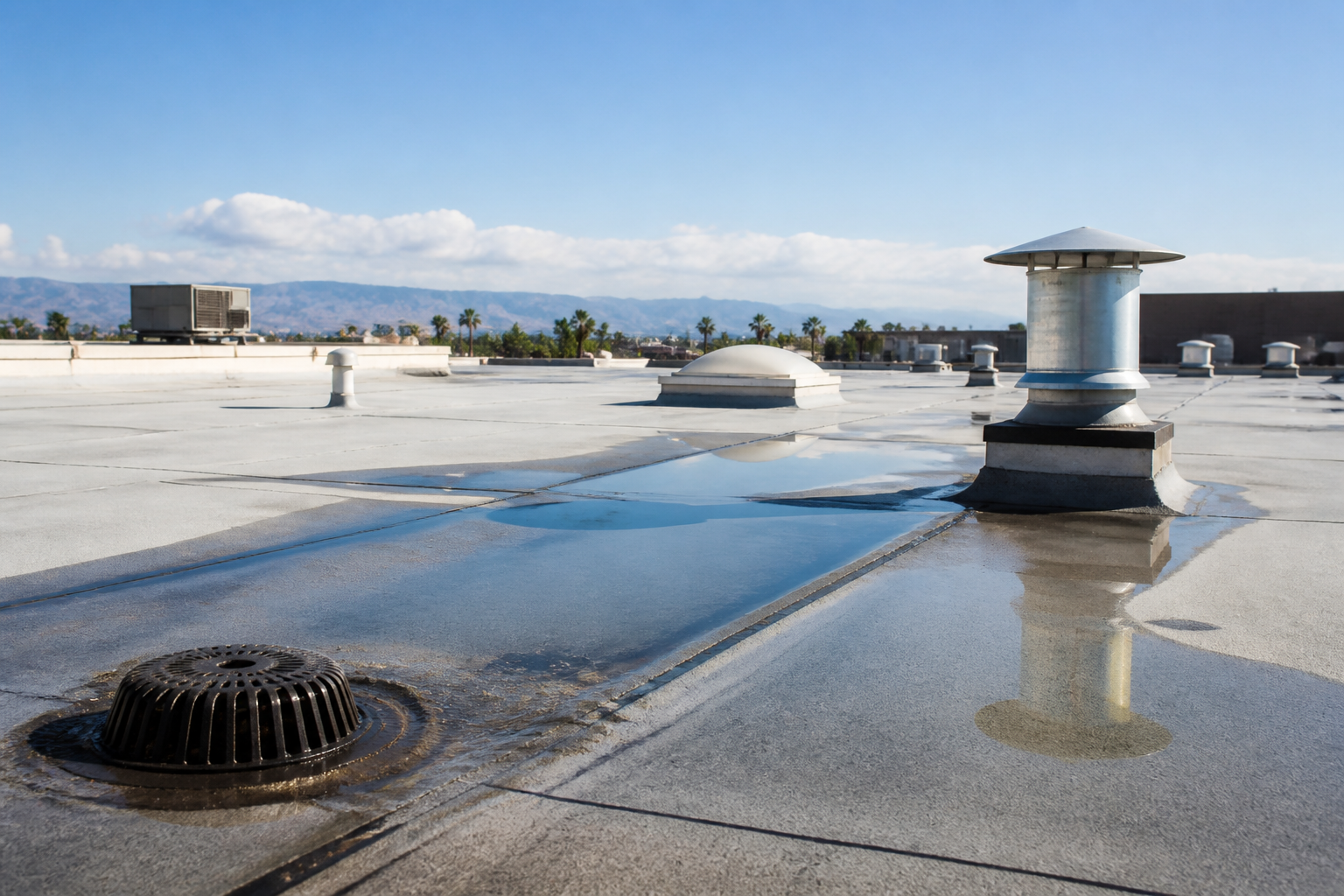
Ponding water is defined as any standing water that remains on a roof surface more than 48 hours after rainfall. On a properly designed and maintained flat roof, water should drain completely within two days. When it doesn’t, you have a problem that compounds over time.
Standing water accelerates membrane degradation, adds significant structural load (water weighs approximately 5.2 pounds per square foot per inch of depth), and creates ideal conditions for algae and vegetation growth that further breaks down roofing materials. On many older commercial buildings in the Los Angeles area, ponding occurs because drains have become blocked, because the roof deck has deflected over time, or because a previous repair created an unintended low spot.
The right fix: Ponding water is a drainage problem, not simply a membrane problem. A contractor who only patches the membrane without addressing why water is collecting there has not fixed the underlying issue. The correct approach involves clearing and inspecting all roof drains, assessing whether additional drains or tapered insulation are needed to correct slope, and then evaluating the membrane condition in ponding areas for deterioration. In many cases, installing tapered insulation panels to create positive drainage toward drains is the most permanent solution.
2. Membrane Separation and Blistering
Flat roofing membranes, whether TPO, PVC, EPDM, or modified bitumen, are designed to form a continuous waterproof barrier. When that barrier is compromised by seam separation, blistering, or cracking, water finds a way in. What makes membrane failure particularly deceptive is that the entry point and the visible interior leak location are often far apart. Water travels horizontally beneath the membrane before finding a path into the building.
Membrane blisters, raised bubbles between the membrane and insulation below, are a warning sign that moisture has already infiltrated the assembly. When those blisters are walked on, patched over carelessly, or simply ignored until they rupture, the result is accelerated failure across a larger area.
The right fix: Small membrane tears or open seams can be addressed with targeted flat roof repair techniques, heat welding for TPO and PVC membranes, compatible patching systems for EPDM, or torch-applied modified bitumen caps for older built-up systems. The critical point is that the repair material must be compatible with the existing membrane and properly adhered well beyond the visible damage zone. A patch that’s six inches bigger than the hole on all sides is the minimum standard. Anything less is a temporary measure.
If membrane damage is widespread, covering 25% or more of the roof surface, or present in multiple disconnected areas, targeted patching becomes an exercise in diminishing returns. That’s when a full restoration conversation becomes appropriate.
3. Deteriorated or Improperly Installed Flashing
Flashing is the metal or membrane material used to seal transitions: where the roof meets a parapet wall, an HVAC curb, a skylight, a vent pipe, or any other penetration. It is, without question, the most common source of flat roof leaks on commercial buildings, and the most frequently underestimated.
Flashing fails for several reasons. In older buildings, original flashing may be galvanized metal that has simply rusted through. In buildings that have had roof work done, flashing may have been improperly installed by a previous contractor, lapped in the wrong direction, inadequately fastened, or caulked rather than properly integrated with the membrane. Caulk is particularly problematic: it’s often used as a shortcut, and it has a lifespan measured in two to three years, not decades.
In Alhambra, CA and throughout the greater Los Angeles area, HVAC equipment on commercial roofs creates a high density of flashing penetrations. Restaurants, retail centers, and office buildings all have multiple rooftop units, and each one is a potential leak point if its curb flashing has not been maintained.
The right fix: Flashing repairs require complete removal of failed material, proper preparation of the substrate, and installation of new flashing that integrates mechanically with the roofing membrane, not just sits on top of it sealed with caulk. If caulk is the only thing standing between your building interior and the next rainstorm, it’s not a repair; it’s a delay.
Our commercial roof repair services always include a full flashing inspection as part of any leak diagnosis, because treating a membrane when the flashing is the actual source of water entry wastes everyone’s time.
4. Blocked or Inadequate Roof Drains
This one is simple in concept but consistently neglected in practice. Flat roofs need drains to function. When drains are blocked by debris, bird nests, accumulated sediment, or vegetation, water backs up across the roof surface. On many commercial buildings in the Los Angeles area, drain covers are rarely inspected between rainy seasons, which means the first heavy rainfall of the year reveals exactly how long the neglect has been building.
Beyond simple blockages, drain design matters. Older commercial buildings may have been built with an insufficient number of drains for the roof area, or drains may have been partially closed off during previous re-roofing work without proper rerouting.
The right fix: Drain clearing is part of any responsible preventive commercial roof maintenance program. But drain clearing alone doesn’t correct underlying slope or drainage design issues. If your building has had recurring ponding in the same locations despite clear drains, the drainage system itself needs to be evaluated, not just cleaned.
A regular commercial roof inspection schedule, at minimum twice annually and after any significant rain event, is the most cost-effective way to catch drain blockages before they become interior leaks.
5. Aged or Improperly Applied Roof Coatings
Many commercial property owners in Southern California have had roof coatings applied at some point, often sold as a “rejuvenation” or “weatherproofing” solution. When applied correctly to a properly prepared surface, quality elastomeric coatings can meaningfully extend membrane life. When applied incorrectly, they create a false sense of security that delays necessary repairs until the damage is far worse.
Common coating failures include: applying coating over wet or contaminated surfaces (which causes adhesion failure and blistering), applying too thin a mil thickness, coating over existing leaks without first repairing them, and using incompatible products on membrane materials that require specific chemistry.
The right fix: Before any coating application, the roof surface must be thoroughly cleaned, all active leaks repaired, all ponding areas addressed, and all flashings inspected and replaced as needed. Our RainArmor seamless cool-roof restoration follows a documented preparation process precisely because skipping steps is what causes coating failures, and coating failures are what send property managers back to square one.
If you’ve had a coating applied in the last few years and you’re still experiencing leaks, it’s worth having an independent assessment of whether the coating was applied correctly and whether it’s still adhering uniformly across the roof surface.
When a Patch Is Enough, and When It Isn’t
Here’s the honest answer that most contractors avoid: targeted repairs are entirely appropriate for isolated, well-defined damage on a roof that is otherwise in good condition and has significant remaining service life. If your roof is eight years old, a single seam has opened due to foot traffic damage, and the surrounding membrane is sound, a proper repair is the right call.
But if your roof is 18 years old, has had multiple patches applied by multiple contractors, has widespread membrane brittleness, deteriorated flashing at most penetrations, and recurring ponding, you are paying for repairs on a system that has already failed systemically. Each patch becomes a game of whack-a-mole, and the cumulative cost of those patches will exceed a restoration within a few years.
To understand all your material options before making that decision, the flat roofing materials installation and cost guide for LA is a useful reference for comparing system types and typical investment ranges in the local market.
Stop the Repeat Leaks, Get a Real Diagnosis
The difference between a repair that lasts and one that doesn’t comes down to the quality of the initial assessment. A contractor who gets on your roof for fifteen minutes and hands you a quote without explaining what they found hasn’t diagnosed your building, they’ve guessed at it.
HP Roofing Pro has served commercial property owners in Alhambra, CA and across Los Angeles County with diagnostic-first roofing inspections that identify the actual sources of failure before any repair work begins. We document what we find, explain it in plain language, and give you a clear recommendation, including when a targeted repair is the right move and when a broader restoration will serve you better long-term.
If your flat roof has leaked more than once after a previous contractor’s repair, that’s not bad luck. That’s a sign the root cause was never properly addressed.
Contact HP Roofing Pro today to schedule a thorough commercial roof assessment and get a second opinion you can actually trust. Our team serves businesses throughout Alhambra, the San Gabriel Valley, and the greater Los Angeles County commercial roofing market, and we’re ready to help you find a permanent solution.
HP Roofing Pro is a licensed commercial roofing contractor based in Alhambra, CA. We specialize in flat roof repair, restoration, and maintenance for commercial and industrial properties throughout Southern California.