Blog
What the Los Angeles Warehouse Fire Teaches Building Owners About Rooftop Risk
June 22, 2026
What the Los Angeles Warehouse Fire Teaches Building Owners About Rooftop Risk
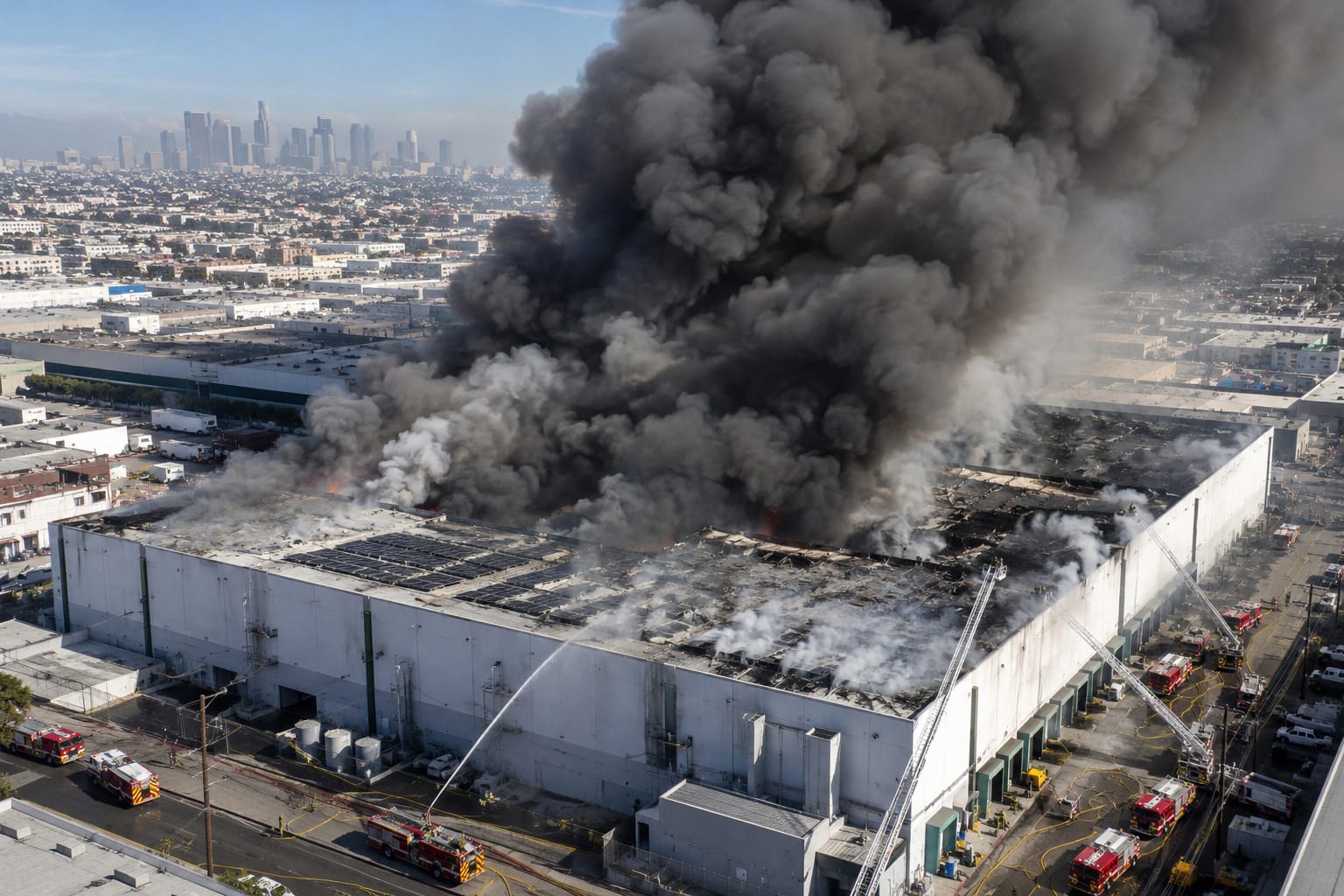
In June 2026, firefighters battled a massive blaze at a cold storage warehouse in Boyle Heights, a fire that began the afternoon of Wednesday, June 18, and burned for the better part of a week. The incident grew serious enough that both Mayor Karen Bass and Governor Gavin Newsom declared states of emergency, and crews resorted to tearing down exterior walls and using heavy water-dropping helicopters to reach flames they couldn’t otherwise get to.
For commercial building owners across Southern California, a fire of this scale is more than a news story. It’s a stress test of every decision made about a roof long before anyone smelled smoke. The roof is where this fire was first reported, where it smoldered for days, and where firefighting tactics ultimately had to change because crews couldn’t safely get to the seat of the fire.
Here is what this incident should teach anyone responsible for a large commercial or industrial roof.
The roof is often where the fire and the problem start
The Boyle Heights blaze was first reported on the roof of a roughly 500,000-square-foot facility. That detail matters. On large industrial buildings, the roof is a working surface crowded with equipment, penetrations, and systems that most owners rarely walk. When something goes wrong up there, it can spread across acres of membrane before anyone on the ground understands the scope.
Once a fire takes hold on a roof that large, the building’s own size works against the response. Firefighters reported zero visibility and unstable interior conditions, and officials said they could not safely send crews inside. The lesson isn’t that big roofs are inherently dangerous, it’s that big roofs demand a level of planning, access, and documentation that smaller buildings can get away with skipping.
Rooftop solar and the access problem
Solar arrays are now standard on warehouse and distribution roofs throughout the region, and they introduce a real complication during a fire. Panels and their racking cover large sections of membrane, the wiring carries live current that can remain energized even when the building’s main power is cut, and dense arrays can physically block the pathways firefighters need to ventilate a roof or cut access holes.
Fire codes require setbacks and clear pathways around rooftop solar for exactly this reason, but those requirements are only as good as the as-built condition of your roof. Arrays get expanded, equipment gets added, and the clear pathways that existed on the original plans quietly disappear. If your building has solar, the question to ask is simple: if the fire department had to get onto your roof tonight, could they actually move across it?
Rooftop mechanical equipment and roof penetrations
Cold storage facilities like the one in Boyle Heights rely on extensive rooftop and building mechanical systems, including ammonia-based refrigeration, and ammonia leaks were among the hazards officials flagged during this fire. Most commercial roofs carry some version of this challenge: HVAC units, exhaust fans, refrigeration lines, gas piping, and the dozens of penetrations that serve them.
Every one of those penetrations is both a potential failure point for water intrusion and a potential complication during a fire. Equipment that isn’t properly mounted, curbs that have deteriorated, and penetrations that were never correctly flashed all become liabilities at the worst possible moment. Knowing exactly what sits on your roof, how it’s anchored, and how it’s sealed is foundational, not optional.
Emergency access pathways and fire department considerations
The single most important lesson from this fire may be about access. Crews changed tactics mid-fight, brought in larger helicopters, and used excavators to tear open walls precisely because conventional access wasn’t working. On a roof, emergency access means clear pathways, structurally sound walking surfaces, unobstructed routes to roof hatches and equipment, and a layout the fire department can actually use under pressure.
Roof structural integrity became a growing concern as the Boyle Heights fire wore on. A roof weakened by age, ponding water, or deferred repairs is a roof that firefighters cannot safely operate on, which removes one of their most effective tools for fighting a fire from above. The condition of your roof directly shapes how, and whether, an emergency response can succeed.
Why roof inspections are the cheapest insurance you’ll ever buy
Almost every risk above is identifiable in advance. Blocked solar pathways, deteriorating equipment curbs, failing penetrations, ponding water, compromised structural decking, none of these appear overnight. They develop slowly, in plain sight, on a surface most owners never visit.
A professional commercial roof inspection documents the condition of the membrane, the equipment, the penetrations, and the structural elements, and it gives you a record you can act on. That documentation is also what protects you afterward: in the wake of a major loss, the difference between an owner who maintained and documented their roof and one who deferred it can be enormous, for insurance, for liability, and for the speed of recovery.
The full accounting of the Boyle Heights fire’s cause and consequences will take time. But the takeaway for every building owner who watched that smoke is available right now, before any emergency forces the question.
Don’t wait for an emergency to find out what’s on your roof. Schedule a commercial roof inspection with HP Roofing Pro and get a clear, documented picture of your building’s rooftop risk.