Blog
Why Your Commercial Roof Keeps Leaking After Repairs: Patching Symptoms vs. Restoring the System
July 2, 2026
Why Your Commercial Roof Keeps Leaking After Repairs: Patching Symptoms vs. Restoring the System
If you manage a commercial property in Alhambra, CA, you know the cycle all too well. A leak shows up after the first heavy rain. You call a roofer, they patch the spot, you write the check. Then three months later, water is coming in again, sometimes in the same place, sometimes two feet away. You call again, pay again, and wonder why your commercial roof keeps leaking after repair work that was supposed to fix the problem.
The frustrating answer is that it probably did fix the problem, the specific problem. But that spot was never really the problem. It was a symptom.
This article explains the structural difference between patching and restoring a commercial roof system, how to recognize when your building has crossed that line, and why a coating-based restoration approach can resolve the root cause for 40 to 60 percent less than a full tear-off and replacement.
Why Spot Patches Fail: The Membrane Degradation Problem
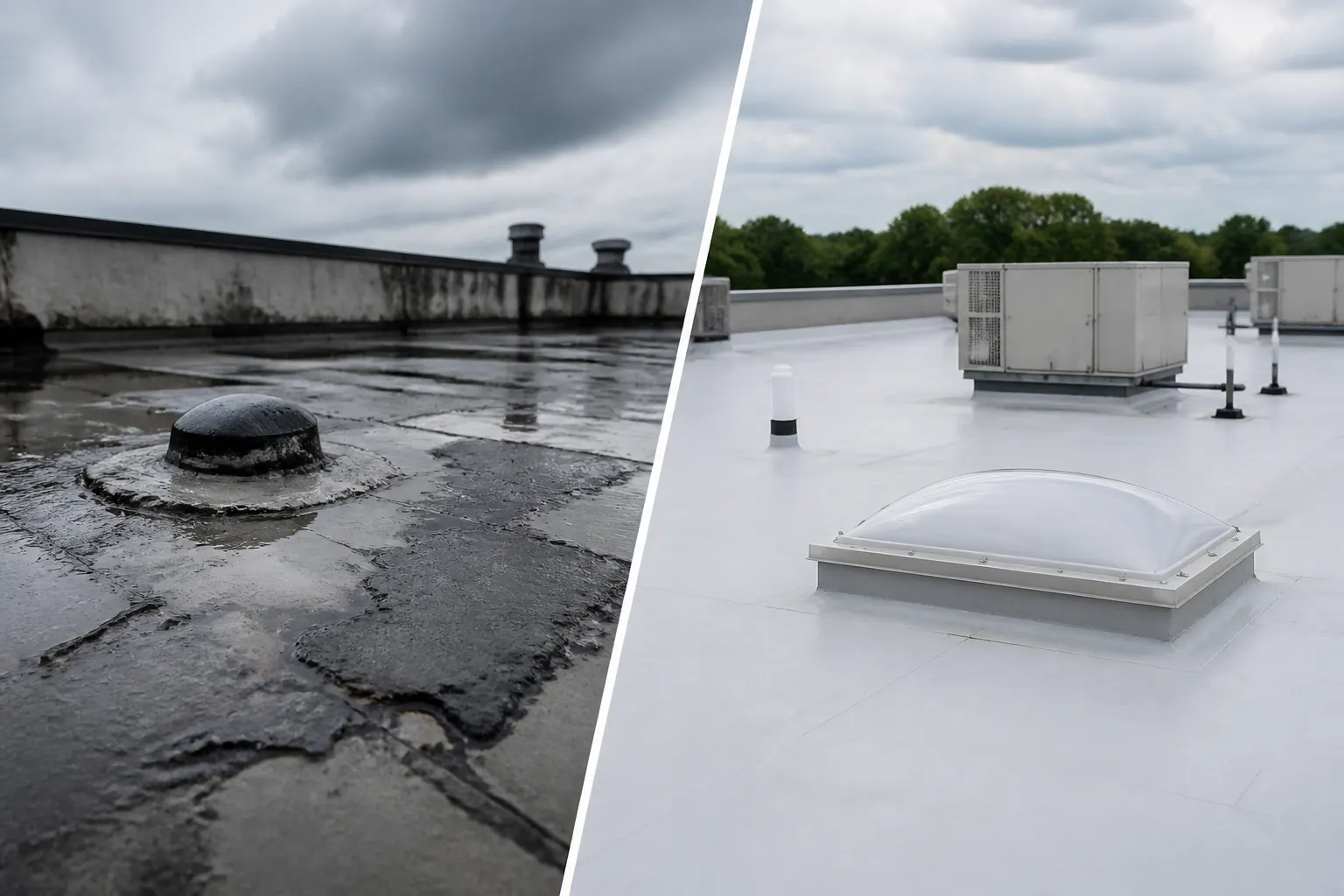
Most commercial flat roofs in the San Gabriel Valley are covered with some form of membrane system, TPO, PVC, modified bitumen, or built-up roofing. When new, these membranes form a continuous, flexible waterproof barrier. Over time, UV exposure, thermal cycling, and foot traffic break down the material at a molecular level.
Here is the part most property managers do not fully understand: membrane degradation is not localized. When one section has weakened enough to fail and allow water in, the material surrounding it has usually degraded to a similar degree. It just has not opened up yet.
When a roofer cuts out a failed section and patches it, they are installing a new, flexible piece of material into a field of old, brittle material. The repair itself may hold perfectly. But the membrane a foot away, or six feet away, is still aged and under stress. Thermal movement, standing water, and the next wind event will find the next weak point. That is why your roof keeps leaking after repair, not because the contractor did bad work, but because patching addresses a failure location while the underlying membrane continues to degrade across the entire surface.
How to Recognize When You Are in Restoration Territory
Repairs make sense when a roof is relatively young, the membrane is in good overall condition, and a failure is clearly isolated, a puncture from foot traffic, a flashing separation at a new penetration, or mechanical damage from an HVAC installation. In those cases, commercial roof repair services are entirely appropriate and cost-effective.
But there are clear signals that tell you the roof has moved beyond repair territory:
Repair frequency is increasing. If you had one repair in year eight and three repairs in year ten, the membrane is actively breaking down across its field. The repairs are no longer getting ahead of the degradation.
You cannot trace leaks to a single visible cause. When a technician gets on the roof and finds widespread surface cracking, checking at laps, or granule loss across large sections, you are looking at systemic failure, not isolated incidents.
Repairs are happening in different locations each time. This pattern tells you the entire membrane is stressed, not one specific area.
The roof is 15 to 20 or more years old. Most commercial membrane systems have a design life in this range. A roof this age that is still leaking after multiple repairs is communicating clearly.
Water is being found between layers. When moisture testing or core sampling finds water trapped in the insulation below the membrane, the system has been compromised for longer than the visible leaks suggest.
At this stage, adding another patch is like changing one bad tire on a car where all four are bald. You fix one failure point and drive straight into the next.
The Hidden Cost of Chasing Leaks
Before deciding between continued repairs and a restoration approach, it helps to put the real numbers on paper. Property managers often think of repairs as the “affordable” option because each individual invoice is smaller than a restoration estimate. But when you add up what you have spent over three or four years chasing the same roof, the math often looks very different.
Consider a 20,000 square foot flat roof on a small commercial building in Alhambra. If that roof generates three repair calls per year at an average cost of $1,200 to $2,000 each, that is $3,600 to $6,000 annually spent without addressing the underlying condition. Over four years, you may have spent $15,000 to $24,000 and still have a deteriorating membrane that is now four years closer to requiring full replacement, which can run $8 to $14 per square foot for a tear-off and re-roof.
There is also the less visible cost: interior damage. Water that makes it through a roof membrane does not stop at the ceiling. It saturates insulation, damages drywall, compromises electrical systems, and can create mold conditions that carry their own remediation expense. Every repair delay or partial fix carries compounding risk that does not show up in the roofing invoice.
For many property owners across Los Angeles, preventive commercial roof maintenance, scheduled inspections and proactive care before failures multiply, turns out to be the strategy that actually reduces total spend over time. But once a roof has entered systemic degradation, maintenance alone cannot reverse the condition.
What Roof Restoration Actually Does Differently
A restoration approach does not remove your existing roof system. Instead, it treats and encapsulates it, then applies a seamless fluid-applied membrane over the entire surface. This is the fundamental difference: rather than addressing specific failure points, restoration reestablishes a continuous waterproof barrier across 100 percent of the roof field.
The process typically involves a thorough inspection and moisture survey, removal or replacement of any sections with wet insulation underneath, repair of significant existing failures, surface preparation and priming, and then application of a reinforced coating system in multiple passes.
The result is a monolithic membrane with no laps, no seams, and no joints, which is where the vast majority of flat roof failures originate. There is no tear-off, no landfill cost, no weeks of disruption to your tenants or operations.
Our commercial roof coating restoration system applies this approach using an elastomeric membrane engineered for Southern California’s UV intensity and thermal load. The finished surface is highly reflective, which also addresses energy consumption, a real consideration for commercial buildings operating under California’s Title-24 requirements.
To understand more about how elastomeric coating technology works and why it performs differently than traditional repairs, the elastomeric coatings guide breaks down the material science behind why these systems outperform patch-based approaches on aging membranes.
The 40 to 60 Percent Cost Advantage Explained
When property owners hear “restoration” they often assume it is nearly as expensive as replacement. In practice, restoration typically costs 40 to 60 percent less than a full tear-off and re-roof. Several factors drive this gap.
No tear-off labor or disposal. Removing an existing commercial roof system and hauling the material to a landfill is expensive. Restoration eliminates this cost entirely.
Existing substrate is preserved. As long as the insulation below the membrane is dry, it does not need to be replaced. This is often the most expensive component of a re-roof.
Faster installation timeline. A restoration project on a 15,000 to 25,000 square foot roof can often be completed in a fraction of the time a full replacement requires, reducing disruption to your business operations.
Warranty coverage that resets the clock. A properly installed restoration system comes with a manufacturer-backed warranty, often 10 to 20 years, that starts fresh. You are not extending the life of an aging system; you are creating a new warranted roof without the replacement cost.
For commercial property owners in Alhambra and across the San Gabriel Valley who are weighing their options, this cost differential is the most concrete decision tool available. If your roof qualifies for restoration, meaning the structural deck is sound and the insulation is dry in enough of the field to warrant it, you can obtain a new warranted waterproof system at roughly half the cost of replacement.
If you are earlier in the decision-making process and want to understand how restoration fits into the broader landscape of commercial roofing options in this region, the best types of roofs for commercial buildings in Southern California is a useful reference for comparing material and system approaches.
When Restoration Is Not the Right Answer
Restoration is not a universal solution, and it is worth being direct about the cases where it is not appropriate.
If moisture testing reveals that a large percentage of the insulation substrate has been saturated for an extended period, the deck and insulation may need to be replaced before any coating system can perform correctly. Applying a coating over wet insulation traps moisture and accelerates structural problems rather than solving them.
If the roof deck itself, the structural substrate below everything else, has been compromised by long-term water intrusion, structural repairs need to happen first.
And if a building is undergoing significant renovation that involves reconfiguring the rooftop layout, adding substantial new penetrations, or changing the drainage plan, it often makes sense to complete that work and then address the roofing system as a coordinated effort.
A qualified contractor will perform moisture scanning and core sampling before recommending restoration, and should be transparent with you if the condition of the roof makes replacement the more appropriate path. If a roofer recommends restoration without conducting any assessment of the substrate condition, treat that as a warning sign.
Stop the Patch Cycle: A Better Path Forward for Alhambra Property Owners
If your commercial roof keeps leaking after repair work, the problem is almost certainly not the quality of the patches. It is that patches are the wrong tool for a roof that has entered systemic membrane degradation.
The real choice is not between repair and restoration, it is between continuing to spend money on a roof that is getting worse, and making a strategic investment that resolves the root cause, resets your warranty coverage, and gives your building a waterproof system designed to last another two decades.
For commercial property owners and managers in Alhambra, CA and the surrounding San Gabriel Valley, HP Roofing Pro specializes in honest roof assessments, coating-based restoration systems, and the kind of transparent recommendations that help you make the right call for your specific building, not the most expensive one.
Contact HP Roofing Pro today to schedule a no-obligation roof assessment. We will inspect your current system, identify whether you are in repair or restoration territory, and give you clear options with real numbers so you can stop the patch cycle for good.
Internal Link Verification
1. /services/commercial-roof-repair/, “commercial roof repair services” (Repair section)
2. /services/commercial-roof-maintenance/, “preventive commercial roof maintenance” (Hidden Cost section)
3. /services/seamless-commercial-roofing/, “seamless cool-roof coating restoration” (Restoration section)
4. /elastomeric-coatings/, “elastomeric coatings guide” (Restoration section)
5. /best-types-of-roofs-for-commercial-roofs-in-southern-california/, “best types of roofs for commercial buildings in Southern California” (Cost section)
6. /locations/professional-commercial-roofing-contractors-in-alhambra-ca/, “Alhambra, CA” (Conclusion)
Total: 6 links. Distributed across 5 different sections. No stacking. No prohibited anchors. Brand name not used as anchor.